

You don’t need a shelf full of hair products to take better care of your hair.
A good hair-care routine can be surprisingly simple:
Clean your scalp → condition your lengths → protect your hair → manage damage → assess what your hair actually needs.
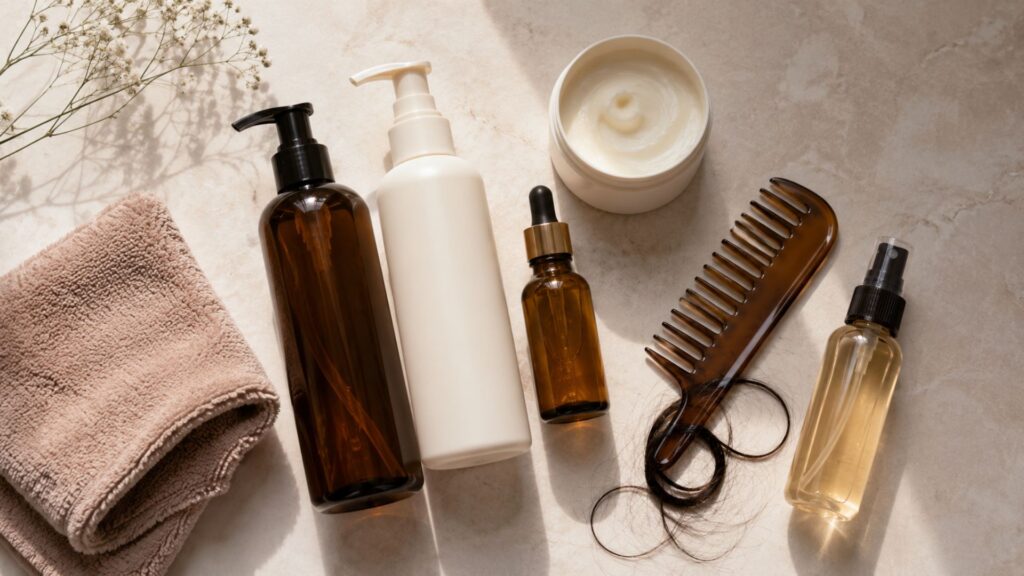
The key is consistency.
For Indian women, however, a weekly routine shouldn’t be copied blindly from someone else’s social-media routine. Hair texture, scalp type, humidity, pollution, heat styling, colouring, chemical treatments and lifestyle can all change what your hair needs.
So instead of asking:
“What is the perfect hair-care routine?”
A better question is:
“What simple routine works for my scalp, hair texture and lifestyle?”
Here’s how to build one.
What Should a Weekly Hair Care Routine Include?
A simple routine can be divided into five parts:
- Scalp cleansing
- Conditioning
- Gentle drying and detangling
- Protection from damage
- One targeted care step
You don’t necessarily need to perform every step every day.
The goal is to create a routine that is simple enough to follow every week.
Step 1: Start With Your Scalp
Your scalp is the foundation of your hair-care routine.
Before deciding how frequently to wash your hair, consider:
- Is your scalp oily?
- Does it become sweaty frequently?
- Do you use styling products?
- Is your scalp comfortable between washes?
- Do you experience persistent itching or flaking?
- Is your hair chemically treated?
- Is your hair naturally dry or curly?
There is no universal “correct” number of washes per week.
The American Academy of Dermatology recommends considering factors such as how oily or dirty your scalp becomes and your hair type when deciding how frequently to shampoo.
Simple rule:
Wash according to your scalp—not according to someone else’s routine.
Step 2: Shampoo the Scalp, Not Aggressively the Lengths
One of the simplest improvements you can make is changing where you concentrate shampoo.
Apply shampoo primarily to your:
Scalp + roots
Then gently massage with your fingertips.
As you rinse, the diluted shampoo can travel through the lengths.
Avoid aggressively rubbing the entire length of your hair.
Why?
The scalp is where oil, sweat and buildup accumulate. Your lengths are generally more vulnerable to dryness and mechanical damage.
Step 3: Condition Your Mid-Lengths and Ends
After shampooing, conditioner helps improve the feel and manageability of the hair.
For many hair types, focus conditioner on:
Mid-lengths → Ends
rather than heavily coating the scalp.
If your hair is very dry, curly or textured, your conditioning needs may be different.
Think of it this way:
Shampoo = scalp cleansing
Conditioner = length care
Step 4: Detangle Gently
Wet hair needs careful handling.
Instead of starting at the roots and dragging a brush through your entire head:
Try:
Ends → Mid-lengths → Roots
Work through tangles gradually.
A suitable wide-tooth comb can be useful for many hair types.
The exact technique should be adapted to your hair texture, especially if you have curly or highly textured hair.
Step 5: Stop Rubbing Your Hair Dry
This small habit can make a big difference to how your hair feels.
After washing:
Don’t aggressively rub.
Instead:
- Gently squeeze excess water.
- Wrap or blot the hair.
- Allow it to dry naturally when practical.
- Minimize unnecessary friction.
Wet hair is more vulnerable to mechanical damage.
Your hair doesn’t need to be attacked with a towel.
Step 6: Add One Weekly Deep-Care Step
This is where many routines become unnecessarily complicated.
You don’t need:
- five masks
- three oils
- multiple serums
- overnight treatments
- ten-step DIY routines
Choose one targeted care step based on what your hair actually needs.
For example:
Dry or frizzy hair
Prioritize conditioning and moisture-focused care.
Chemically treated hair
Focus on reducing additional damage and maintaining softness and manageability.
Heat-styled hair
Prioritize heat protection and reducing unnecessary heat exposure.
Curly or textured hair
Prioritize gentle cleansing, conditioning and careful detangling.
Healthy, low-maintenance hair
You may need very little beyond your basic cleansing and conditioning routine.
Your Simple Weekly Hair Care Routine
Here’s a practical starting framework.
| Day | Routine |
|---|---|
| Monday | Normal hair care + gentle styling |
| Tuesday | Minimal handling + protect from unnecessary heat |
| Wednesday | Wash according to scalp needs |
| Thursday | Gentle detangling + serum/leave-in if appropriate |
| Friday | Minimal styling and friction |
| Saturday | Wash + conditioner |
| Sunday | Weekly targeted care / hair assessment |
But don’t treat this calendar as a rule.
Your scalp and hair condition should determine the actual washing days.
For someone with an oilier scalp, washing may need to happen more frequently.
Someone with dry, curly or textured hair may need a different schedule.
A Better Way to Think About Your Week
Instead of assigning a product to every day, divide your routine into three levels.
Daily: Protect
Focus on:
- Gentle handling
- Avoiding unnecessary heat
- Avoiding excessive tension
- Protecting hair while sleeping if appropriate
- Reducing friction
Wash Day: Clean + Condition
Your basic wash-day sequence:
Shampoo → Condition → Gentle detangling → Gentle drying → Leave-in/serum if appropriate
That’s enough for many people.
Weekly: Assess + Target
Once a week, ask:
What does my hair actually need right now?
Is it:
Dry?
Frizzy?
Tangled?
Over-processed?
Heavy with buildup?
Breaking?
Comfortable and healthy-looking?
Your weekly care step should respond to the answer.
Example Routine for Dry, Frizzy Indian Hair
If your primary problem is dryness and frizz, your routine could look like:
Wash Day
1. Gentle shampoo
Focus on the scalp.
↓
2. Conditioning
Focus on lengths and ends.
↓
3. Gentle detangling
Avoid aggressive pulling.
↓
4. Blot dry
Avoid vigorous towel rubbing.
↓
5. Leave-in or serum
If suitable for your hair.
↓
6. Heat protection
If you’re going to use heat.
↓
7. Minimize unnecessary styling
Let the hair rest when practical.
Example Routine for Oily Scalp + Dry Ends
This combination is extremely common.
Your roots may become oily quickly while the lengths still feel dry.
The answer isn’t necessarily to treat the entire head as oily.
Instead:
Scalp: Clean appropriately.
Lengths: Condition appropriately.
Ends: Minimize friction and heat damage.
This is why identifying your scalp type and hair condition separately can make your routine more effective.
Example Routine for Chemically Treated Hair
If you regularly colour, straighten, smoothen or chemically process your hair, your routine should place greater emphasis on damage prevention.
Prioritize:
- Gentle cleansing
- Regular conditioning
- Reduced excessive heat
- Heat protection
- Gentle detangling
- Professional assessment when needed
- Appropriate home-care products
Don’t repeatedly apply aggressive chemical processes to already fragile lengths without professional guidance.
Example Routine for Curly or Wavy Hair
Curly and wavy hair can have different cleansing and conditioning requirements from straight hair.
A simple routine may involve:
Gentle cleansing
↓
Generous conditioning
↓
Careful detangling
↓
Leave-in/styling product if appropriate
↓
Minimal manipulation while drying
The goal isn’t to make curly hair behave like straight hair.
The goal is to keep its natural texture manageable and healthy-looking.
What About Hair Oiling?
For many Indian women, oiling is an important traditional hair-care practice.
But oiling doesn’t have to become a complicated ritual.
If you enjoy oiling and it suits your scalp and hair, it can be incorporated into your routine.
However, more oil isn’t automatically better.
Heavy oiling may not suit everyone, particularly people with certain scalp concerns.
The important question is:
Does oiling make your hair feel and behave better—or is it simply something you’re doing because you’ve always done it?
What About Hair Masks?
A hair mask can be useful when your hair needs additional conditioning.
But don’t automatically use a mask several times a week.
For many people, a regular conditioner may already provide sufficient conditioning.
Use targeted care when there is a reason for it.
If your hair is:
- dry
- rough
- frizzy
- chemically processed
- difficult to manage
a suitable treatment may be worth considering.
What About Heat Styling?
Your weekly routine should include a heat budget.
Ask yourself:
How many times am I actually using heat?
If you’re using a straightener or curling iron every day, reducing frequency may be more valuable than buying another hair mask.
When heat styling:
Use heat protection + sensible temperature + minimal passes.
And whenever practical, give your hair heat-free days.
What About Hair Fall?
Don’t automatically turn a weekly hair routine into a hair-loss treatment.
Some shedding is normal.
But persistent or significant hair loss can have many possible causes, including medical and hormonal factors.
Watch for:
- sudden increase in shedding
- visible thinning
- widening part
- bald patches
- receding hairline
- persistent scalp symptoms
If these occur, consider seeing a dermatologist rather than simply adding more cosmetic hair products.
The 10-Minute Weekly Hair Check
Once a week, stand in front of a mirror and check your hair.
Look at your:
Scalp
Does it feel comfortable?
Roots
Are they excessively oily or weighed down?
Mid-lengths
Do they feel dry or rough?
Ends
Are they splitting, tangling or breaking?
Hairline
Is there unusual thinning or tension?
Overall texture
Does your hair feel softer or more damaged than it did last week?
This simple check can help you adjust your routine before problems become bigger.
7 Hair-Care Habits Worth Keeping Every Week
1. Clean your scalp appropriately
Don’t follow a rigid washing schedule.
2. Condition your lengths
Especially if your hair is dry or chemically treated.
3. Detangle gently
Work from the ends upward.
4. Reduce friction
Be gentle when drying and handling wet hair.
5. Control heat
Reduce frequency and use protection.
6. Avoid excessive tension
Constantly tight ponytails and buns can stress the hair.
7. Keep the routine simple
Consistency beats complexity.
Your Simple Weekly Hair Routine Checklist
Save this checklist:
☐ Wash according to scalp needs
☐ Shampoo primarily at the scalp
☐ Condition the lengths
☐ Detangle gently
☐ Avoid aggressive towel drying
☐ Reduce unnecessary heat
☐ Use heat protection when styling
☐ Avoid excessively tight hairstyles
☐ Do one targeted care step if needed
☐ Check your scalp, lengths and ends once a week
When Should You Get a Professional Hair Assessment?
Sometimes your routine isn’t the problem.
You may simply be treating the wrong problem.
For example:
Dryness ≠ hair loss
Frizz ≠ necessarily damage
Breakage ≠ shedding
Dandruff ≠ simply dry scalp
Oily roots + dry ends ≠ oily hair everywhere
A professional hair assessment can help identify visible differences in hair texture, condition, damage and styling history.
At Kapil’s Salon, a professional consultation can help you understand your hair’s current condition and choose an appropriate salon and home-care approach.
For persistent scalp symptoms or unexplained hair loss, consult a dermatologist.
Frequently Asked Questions
What is the best weekly hair-care routine?
A simple weekly routine generally includes appropriate scalp cleansing, conditioning, gentle detangling and drying, protection from excessive heat and tension, plus targeted care based on your hair’s needs.
How many times should I wash my hair per week?
There is no universal number. Washing frequency should depend on your scalp’s oiliness, hair type, activity level and buildup.
Should I oil my hair every week?
Not necessarily. Oiling can be part of a routine if it suits your hair and scalp, but there is no requirement for everyone to oil weekly.
Should conditioner be applied to the scalp?
For many hair types, conditioner is best concentrated on the mid-lengths and ends rather than heavily applied to the scalp.
How can I reduce frizz naturally?
Start by reducing unnecessary friction, aggressive towel drying, excessive heat and harsh handling. Appropriate conditioning and leave-in products may also help manage frizz.
Is a weekly hair mask necessary?
No. A hair mask is not automatically necessary every week. Whether you need one depends on your hair’s condition, texture and chemical or heat exposure.
What should I do if my hair keeps breaking?
Reduce heat and chemical stress, handle the hair gently, condition appropriately and consider a professional assessment to identify the likely source of damage.
Can a weekly routine stop hair fall?
A good hair-care routine can help reduce avoidable mechanical and cosmetic damage, but it cannot treat every cause of hair loss. Persistent or significant hair loss should be professionally evaluated.
Final Takeaway
A good hair-care routine doesn’t need to be complicated.
You don’t need 20 products and 15 steps.
Start with:
Clean the scalp.
Condition the lengths.
Handle hair gently.
Protect it from heat and tension.
Give it targeted care when needed.
Review your routine every week.
The best weekly hair-care routine is not the most expensive one.
It’s the one that matches your scalp, hair type, lifestyle and actual hair needs—and that you can consistently follow.