
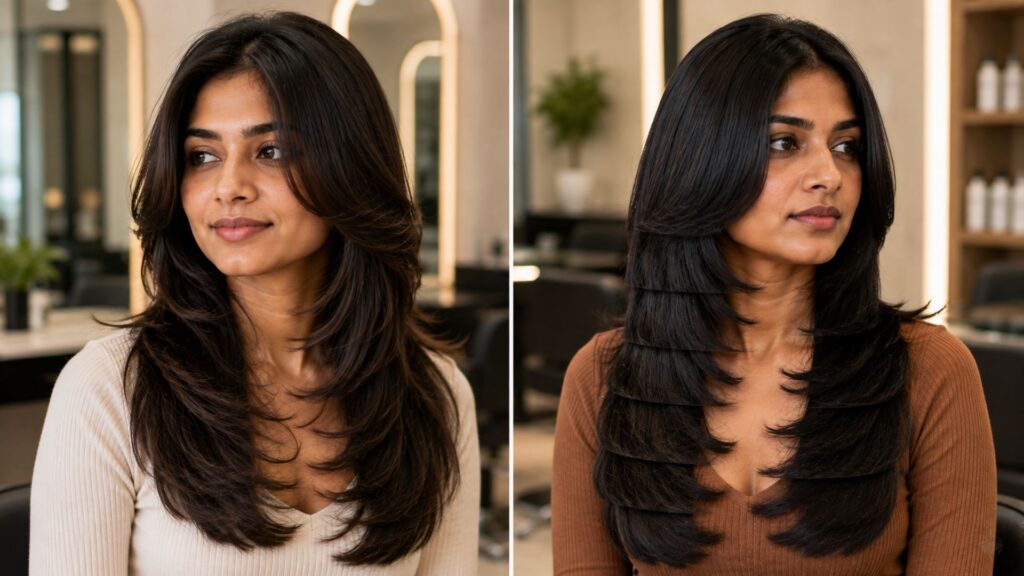
Layer Cut vs Step Cut: What’s the Difference?
The main difference between a layer cut and a step cut is how the lengths transition through the hair. A layer cut creates blended, gradual differences in length for movement and softness, while a step cut creates more noticeable sections or “steps” between different lengths. The right choice depends on your hair texture, density, face shape, desired volume and styling routine.
If you’ve ever shown a hairstyle picture to your hairstylist and wondered whether you need a layer cut or step cut, you’re not alone.
Both haircuts can add shape and movement—but they create very different results.
Let’s break down the difference.
What Is a Layer Cut?

A layer cut is created by cutting different sections of the hair at varying lengths and blending those lengths together.
The transitions are generally designed to look gradual rather than visibly separated.
The result can be:
- More movement
- Softer shape
- Better distribution of weight
- Face-framing
- Added texture
- A more flowing silhouette
Layers can be customized to suit short, medium or long hair.
They can also be adapted for straight, wavy and curly hair.
Example
Imagine long hair where the shortest pieces around the face gradually blend into longer sections and eventually into the overall length.
That is the basic idea behind layering.
What Is a Step Cut?
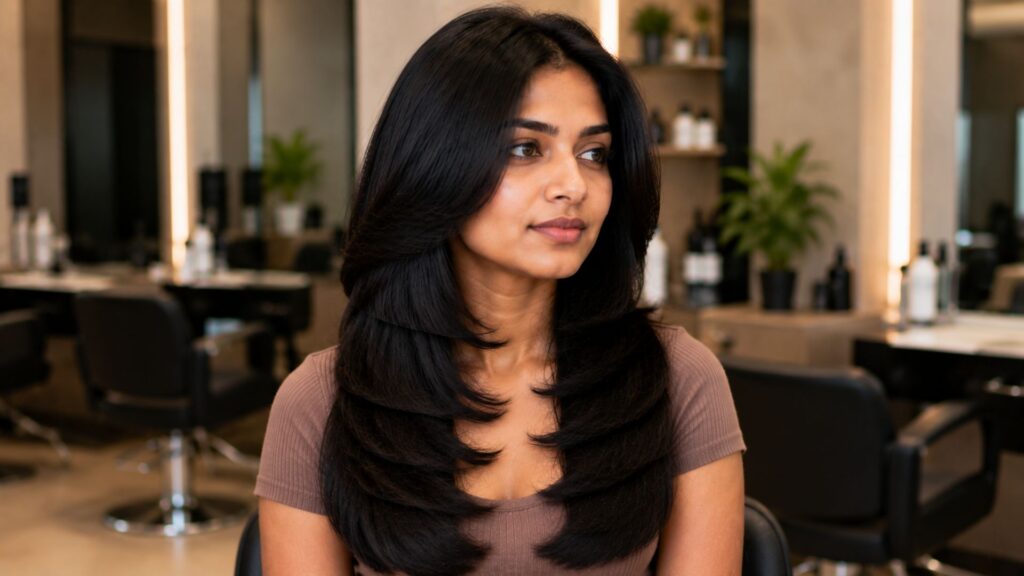
A step cut creates more clearly defined differences between sections of hair.
Instead of blending every length gradually, the haircut can create distinct levels that appear more like steps.
This can give the hairstyle:
- More visible separation
- A stronger layered effect
- Defined movement
- A more dramatic silhouette
- Noticeable volume at selected areas
The classic step-cut effect is often associated with clearly separated sections around the crown, sides or lower lengths.
However, a modern stylist can customize how pronounced those steps appear.
Layer Cut vs Step Cut: Quick Comparison
| Feature | Layer Cut | Step Cut |
|---|---|---|
| Length transition | Gradual and blended | More noticeable |
| Overall appearance | Soft and flowing | Defined and structured |
| Movement | Natural and blended | More separated |
| Volume | Can be controlled throughout | Can create stronger volume at specific levels |
| Face framing | Highly customizable | Usually more visibly segmented |
| Finish | Soft, polished | Bold, defined |
| Best for | Many hair types and styles | Those wanting a more noticeable layered effect |
| Maintenance | Depends on layer placement | Depends on number and height of steps |
Layer Cut vs Step Cut: The Biggest Difference
The easiest way to understand the difference is to look at the transition between lengths.
Layer Cut
Short → slightly longer → longer → longest
The changes are blended.
Step Cut
Short → distinct level → longer level → longest
The changes are more visible.
Neither haircut is automatically better.
They’re simply different techniques designed to create different shapes.
What Does a Layer Cut Look Like?
A layer cut generally has a more continuous flow through the hair.
Depending on the design, your stylist can create:
Long layers
Subtle movement while retaining most of your length.
Medium layers
More noticeable movement and shape.
Face-framing layers
Layers positioned around the face to complement your features.
Short layers
Greater movement and texture, particularly through the upper sections.
The important point is that “layer cut” doesn’t describe just one hairstyle.
It describes a cutting approach that can be customized extensively.
What Does a Step Cut Look Like?
A step haircut usually has more obvious changes in length.
For example, the hair may have:
- Shorter sections around the crown
- A longer second level
- Another longer section through the lower lengths
These distinct levels create the characteristic “step” appearance.
A step cut can therefore look more dramatic than a softly layered haircut.
Which Gives More Volume: Layer Cut or Step Cut?
Both can create volume, but they do it differently.
A layer cut can create controlled movement and distribute weight throughout the hair.
A step cut can create more noticeable volume at specific levels because of the stronger differences in length.
However, haircut alone doesn’t determine volume.
Your:
- Hair density
- Individual strand thickness
- Natural texture
- Styling technique
- Hair condition
also make a significant difference.
For fine hair, excessive layering or stepping may sometimes make the ends appear thinner.
For thick hair, strategic layering can help manage weight.
Which Is Better for Long Hair?
Both can work beautifully on long hair.
Choose long layers if you want:
- To retain length
- Soft movement
- Face framing
- A flowing appearance
- Versatile styling
Consider a step effect if you want:
- More visible separation
- Stronger shape
- Noticeable levels
- A more dramatic haircut
If you are unsure, ask your stylist to show you where the shortest layer or step will sit before cutting.
Which Is Better for Medium-Length Hair?
Medium-length hair provides plenty of flexibility.
A layered haircut can create a soft, polished shape, while a step cut can create more visible dimension.
Your stylist may also combine techniques.
For example, a haircut could have soft layers with strategically defined sections rather than being a strict traditional layer or step cut.
This is why showing your stylist a reference photo can be helpful—but the haircut should be adapted to your own hair.
Which Is Better for Short Hair?
Short haircuts rely heavily on shape and weight distribution.
Layers can be used to:
- Create texture
- Remove excess weight
- Add movement
- Build shape
Step-like graduation or clearly separated sections can create a more structured appearance.
For short hair, the exact cutting technique matters more than the name of the haircut.
Layer Cut for Straight Hair
Straight hair can show the shape of a haircut particularly clearly.
A layered cut can add movement to otherwise uniform lengths.
Popular approaches include:
- Long layers
- Face-framing layers
- Butterfly-inspired layers
- Soft medium layers
- Layered lobs
For fine straight hair, however, excessive layering may reduce the appearance of fullness.
Layer Cut for Wavy Hair
Wavy hair can work particularly well with customized layering.
Layers can help natural waves move rather than sitting as one heavy mass.
A stylist should consider how the hair behaves when it dries naturally.
This is important because wavy hair can appear shorter or more voluminous after drying.
Layer Cut for Curly Hair
Curly hair requires an even more personalized approach.
The stylist needs to consider:
- Curl pattern
- Shrinkage
- Density
- Weight distribution
- Natural volume
- How the curls sit when dry
A layered curly haircut can create shape and movement without treating curls like straight hair.
Step Cut for Indian Hair
Indian hair can range from fine and straight to thick, wavy or curly.
Many Indian women also have relatively dense hair, which means the same haircut can behave differently depending on the amount of hair and individual strand thickness.
A step cut can create visible movement in thick hair, but the number and placement of steps should be carefully considered.
A professional stylist can determine whether a more defined step structure or blended layering will create the result you want.
Layer Cut vs Step Cut for Face Shape
Your face shape can also influence the placement of layers or steps.
Round Face
Longer face-framing layers can create vertical movement.
Square Face
Soft layers around the face can introduce movement around stronger facial angles.
Oval Face
Many different layer lengths and silhouettes can work well because of the naturally balanced proportions.
Heart-Shaped Face
Face framing can be customized to balance the forehead, cheekbones and chin.
Long or Oblong Face
The placement of layers and volume can be adjusted to create a more balanced overall silhouette.
But face shape should never be the only factor.
Your natural hair texture and density are equally important.
Can You Combine Layer and Step Cuts?
Yes.
Modern haircuts don’t always fit neatly into one category.
A stylist may combine:
- Soft long layers
- Defined sections
- Face-framing layers
- Graduated lengths
- Texturizing
- Internal layers
This allows the haircut to be customized instead of forcing your hair into a fixed template.
For example, you might want the softness of layers through the front while keeping more defined length changes through the back.
Layer Cut vs Step Cut: Which Is Easier to Maintain?
Maintenance depends more on the specific haircut design than simply whether it is called a layer or step cut.
Consider:
How short the shortest section is
How quickly your hair grows
Whether you style your hair regularly
Whether you want to maintain a specific shape
Your natural texture
Whether you want to grow the haircut out
A subtle long-layer haircut may be relatively easy to maintain.
A more structured haircut with pronounced sections may require more regular shaping to maintain its intended silhouette.
For those interested in learning professional hair and beauty techniques, a makeup academy can also provide valuable training and practical skills.
Common Mistakes When Choosing Between Layers and Steps
1. Choosing Based Only on a Photograph
The model’s hair density, texture and face shape may be completely different from yours.
Use photographs as inspiration—not as an exact template.
2. Asking for “Maximum Layers”
More layers don’t automatically mean more volume.
Too much layering can sometimes reduce the visual fullness of the ends.
3. Ignoring Your Natural Texture
A haircut designed for straight hair may behave differently on waves or curls.
Always discuss how you normally wear your hair.
4. Not Explaining Your Desired Result
Tell your stylist whether you want:
Soft + natural
or
Defined + dramatic
That can help determine whether blended layers, stronger steps or a combination would be appropriate.
Layer Cut or Step Cut: Which One Should You Choose?
A simple way to decide is to start with the look you want.
Choose a Layer Cut if you want:
✔ Soft movement
✔ Blended transitions
✔ Face-framing
✔ A flowing appearance
✔ Flexible styling
Consider a Step Cut if you want:
✔ More visible length separation
✔ Defined levels
✔ A stronger silhouette
✔ Noticeable movement
✔ A more dramatic layered appearance
And if you want something in between, ask your stylist about a customized combination of layering and defined sections.
The Right Haircut Is About More Than Its Name
“Layer cut” and “step cut” are useful terms, but they don’t tell the whole story.
A professional haircut should consider:
Face shape
- Hair texture
- Hair density
- Hair length
- Hair condition
- Lifestyle
- Styling preference
Two people can request the same “layer cut” and receive completely different haircuts—and that can be exactly what they need.
Get a Personalized Haircut Consultation at Kapil’s Salon
At Kapil’s Salon, your stylist can assess your hair texture, density, length and facial proportions before recommending the most suitable cutting approach.
Whether you prefer soft blended layers, defined steps or a customized combination, the objective is to create a haircut that works with your natural hair and fits your lifestyle.
Ready to find the right haircut for you?
Book a haircut consultation at Kapil’s Salon and discuss whether layers, steps or a customized approach will work best for your hair.
Frequently Asked Questions
Is a layer cut and step cut the same?
No. A layer cut generally uses more gradual, blended differences in length, while a step cut creates more noticeable changes between sections.
Which is better, layer cut or step cut?
Neither is universally better. The right option depends on your hair texture, density, length, face shape, desired look and maintenance preferences.
Does a step cut give more volume than layers?
A step cut can create more noticeable volume at specific levels, while layers can create more distributed and controlled movement. Your natural hair density also affects the result.
Is a layer cut good for thin hair?
It can be, but the amount and placement of layers are important. Excessive layering may make the ends appear less full, so a customized approach is preferable.
Is step cut good for thick hair?
It can work well for thick hair when the steps are strategically placed. Your stylist should consider how much weight needs to be retained or removed.
Which haircut is better for long hair?
Both can work. Long layers are a good option for retaining length while adding movement, whereas a step cut can create more visibly separated sections.
Can curly hair have a step cut?
Yes, but curly hair needs customized cutting based on curl pattern, shrinkage and density. The final shape should be assessed with the natural curl pattern in mind.
Can layer and step cuts be combined?
Yes. A stylist can combine blended layers, defined sections and face framing to create a customized haircut rather than following one rigid technique.
Expert Review by Mr. Kapil Sharma
Founder & Creative Director, Kapil’s Salon & Academy