
The Short Answer
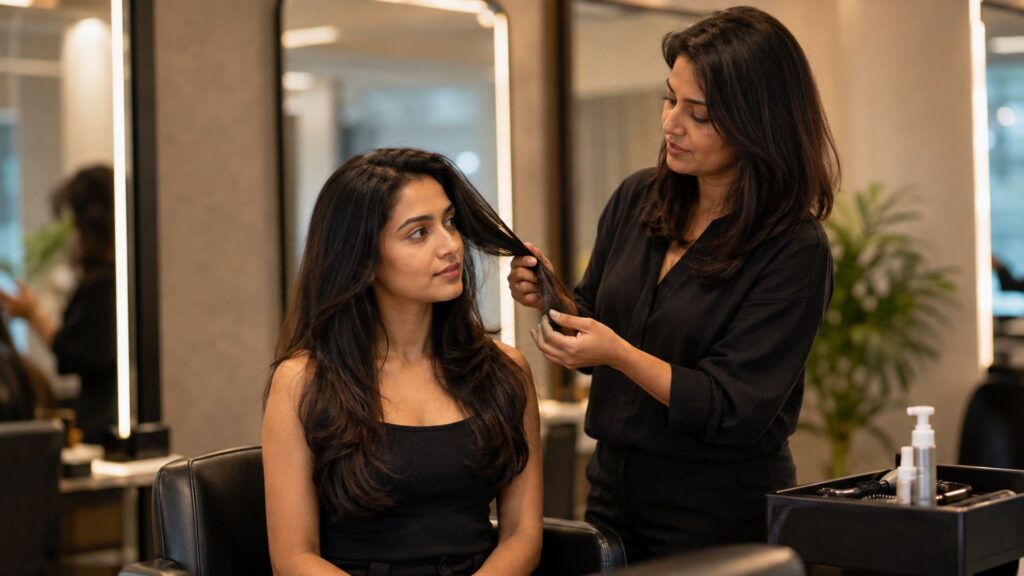
The right women’s haircut depends on your hair texture, density, face proportions, current length, hair condition, lifestyle and styling habits—not just your face shape. A good haircut should work with the way your hair naturally behaves and the amount of maintenance you’re realistically willing to do. Professional stylists also consider how the cut will look as it grows out.
Choosing a haircut is therefore less about finding a universally “best” haircut and more about finding the best haircut for you.
A photo of a celebrity haircut can be an excellent reference, but your final cut may need different lengths, layers or weight distribution because your hair behaves differently.
This complete guide explains how to choose a haircut based on your face shape, hair type, density, length, lifestyle and maintenance preference.
What Should You Consider Before Getting a Haircut?
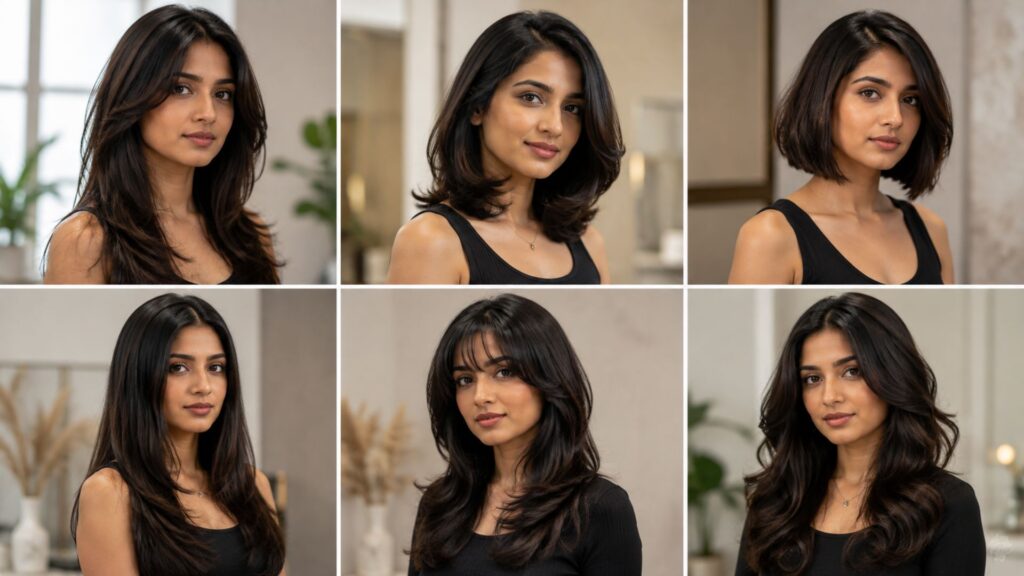
Before choosing a haircut, look at these seven factors:
- Face proportions
- Hair texture
- Hair density
- Current hair length
- Hair condition
- Daily styling routine
- How much maintenance you want
Hair texture and density are particularly important. Hair can differ considerably in texture, density and porosity, so the same cutting technique won’t necessarily produce the same result on different hair.
Think of your haircut as a formula:
Face + Texture + Density + Length + Lifestyle + Maintenance = Haircut Strategy
1. How Do I Choose a Haircut for My Face Shape?
Face shape can be a useful starting point, but it shouldn’t become a strict rule.
Common face-shape categories include:
- Oval
- Round
- Square
- Oblong or long
- Heart
- Diamond
A professional consultation should look beyond the label and consider your actual facial proportions, hairline, features and preferred look.
For example, stylists may use length, angles, layers and fringe placement to alter the visual balance around the face.
Haircuts for Oval Faces
Oval faces are relatively balanced in proportion, which gives you considerable flexibility.
You can explore:
- Long layers
- Bobs
- Lobs
- Face-framing layers
- Curtain bangs
- Medium-length cuts
- Long blunt cuts
- Textured styles
But don’t stop at:
“I have an oval face.”
Your hair texture may ultimately determine whether a particular version of the haircut works well.
Haircuts for Round Faces
If your face has softer, fuller proportions, you may prefer haircuts that introduce length, angles or vertical movement.
Possible directions include:
- Longer layers
- Face-framing layers
- Longer bobs
- Angled bobs
- Side-swept fringe
- Long textured styles
Some professional haircut approaches use longer layers and strategic angles to create additional visual structure around a rounder face.
But remember:
The goal isn’t to “hide” a round face.
The goal is to create a shape you personally find flattering.
Haircuts for Square Faces
A stronger jawline can work beautifully with both structured and soft haircuts.
Consider:
- Long layers
- Soft textured lobs
- Wavy styles
- Face-framing layers
- Soft fringe
- Long hair with movement
You don’t necessarily need to disguise angular features. A haircut can instead emphasize them and make them part of your overall look.
Haircuts for Long or Oblong Faces
For a longer face shape, you may prefer hairstyles that introduce some width and movement around the sides.
Possible options include:
- Shoulder-length cuts
- Medium layers
- Curtain bangs
- Side-swept fringe
- Face-framing layers
- Soft waves
The position of layers and fringe can change how the overall proportions of the face are perceived.
Haircuts for Heart-Shaped Faces
A heart-shaped face often has a broader upper face and a narrower chin.
Potential haircut directions include:
- Chin-length bobs
- Long layers
- Curtain bangs
- Side-swept fringe
- Face-framing layers
- Medium-length waves
The objective is to create a balanced overall silhouette rather than following a rigid formula.
2. What Haircut Is Best for Straight Hair?
Straight hair tends to show the structure and perimeter of a haircut clearly.
Possible options include:
Blunt cuts
Strong, clean ends can create a polished appearance.
Bobs
A structured bob can work particularly well when the hair naturally falls straight.
Lobs
A longer bob gives you versatility while retaining useful length.
Long layers
These introduce movement without necessarily creating a highly layered silhouette.
Face framing
This can add movement around the face without dramatically changing the overall length.
3. What Haircut Is Best for Wavy Hair?
Wavy hair already has natural movement, so the haircut should generally work with that movement rather than constantly fight it.
Possible approaches include:
- Long layers
- Soft face framing
- Textured lobs
- Medium-length layers
- Shag-inspired shapes
The final result depends on how the waves behave when completely dry.
4. What Haircut Is Best for Curly Hair?
Curly hair requires special attention because curl pattern, density and shrinkage can significantly influence the finished shape.
Possible haircut approaches include:
- Curly layers
- Rounded shapes
- Long layered cuts
- Curly bobs
- Face-framing curls
A stylist should ideally understand how the hair behaves naturally rather than designing the haircut entirely around a temporarily straightened finish.
Hair texture can substantially influence how cutting techniques perform.
5. What Haircut Is Best for Thick Hair?
Thick hair gives you plenty of styling possibilities, but excessive weight can sometimes make a haircut feel bulky.
The goal is controlled weight distribution, not simply removing as much hair as possible.
Depending on the desired result, your stylist may consider:
- Long layers
- Internal layering
- Graduation
- Face framing
- Strategic weight removal
- Textured ends
A step or heavily layered approach, for example, can work particularly well on some thick or wavy hair because removing weight can create movement—but sharply separated layers may not be ideal for fine hair.
6. What Haircut Is Best for Fine or Thin Hair?
First, understand the difference.
Fine hair refers primarily to the diameter of individual strands.
Thin hair usually refers to lower overall density.
You can have fine hair with relatively high density, or thicker strands with lower density.
For finer-looking hair, controlled shapes can sometimes make the ends appear fuller.
Potential options include:
- Blunt bob
- Blunt lob
- One-length haircut
- Minimal layers
- Carefully placed face framing
The wrong haircut can sometimes make fine hair appear flatter or less dense. A strategically designed cut can instead create the visual impression of fullness.
Important: A haircut cannot increase the number of hair follicles or actually create new hair growth.
7. Layers vs One-Length Haircuts: Which Is Better?
Neither is universally better.
It depends on your objective.
One-Length Haircut
A one-length cut creates a strong perimeter.
It can be useful when you want:
- A clean silhouette
- Fuller-looking ends
- A sleek appearance
- Minimal layering
- A strong bob or lob
Layered Haircut
Layers redistribute weight and introduce movement.
They can be useful for:
- Thick hair
- Long hair
- Wavy hair
- Curly hair
- Creating movement
- Reducing excessive weight
The key is where the layers start and how much weight is removed.
8. What Are Face-Framing Layers?
Face-framing layers are shorter pieces around the face that connect into the rest of the haircut.
They can be customized around:
- Cheekbones
- Jawline
- Chin
- Lips
- Shoulders
There is no single correct starting point.
A stylist can adjust the starting point depending on the facial proportions and the look you want.
9. Should You Get Bangs?
Bangs can dramatically change a haircut.
Popular options include:
- Curtain bangs
- Side-swept fringe
- Blunt fringe
- Wispy bangs
- Textured fringe
- Longer face-framing fringe
But ask yourself one question first:
“Am I willing to maintain them?”
Bangs can require more frequent trimming and styling than the rest of the haircut.
If you are looking for a low-maintenance style, discuss this before cutting.
10. Which Haircut Length Should You Choose?
Short Hair
Short hair can create a strong, distinctive silhouette.
Options include:
- Pixie
- Bixie
- Bob
- French-inspired bob
- Graduated bob
Shorter cuts can also require more frequent shape maintenance.
Medium Hair
Medium-length hair is highly versatile.
Think:
Chin → Shoulder → Collarbone
You can combine this length with:
- Layers
- Face framing
- Curtain bangs
- Waves
- Textured ends
A lob is one of the most adaptable options in this category.
Long Hair
Long hair gives you significant styling flexibility.
But simply keeping all the hair at one length isn’t your only option.
You can introduce:
- Long layers
- Face framing
- U-shaped perimeter
- V-shaped perimeter
- Butterfly-inspired layering
- Long curtain fringe
The objective is to retain the length while creating a deliberate shape.
11. What Is a Low-Maintenance Haircut?
A low-maintenance haircut isn’t necessarily a haircut that never needs styling.
It’s a haircut designed to work reasonably well with your natural hair and lifestyle.
Tell your stylist if you:
- Have only five minutes to style your hair
- Exercise frequently
- Usually tie your hair up
- Don’t use heat regularly
- Prefer air-drying
- Visit the salon infrequently
If you want minimal styling, say this explicitly:
“I want a haircut that looks good with my natural texture and doesn’t require daily heat styling.”
That one sentence can significantly change the consultation.
12. Consider Your Hair Condition Before Cutting
Your haircut should take your existing hair condition into account.
Tell your stylist if your hair has been:
- Coloured
- Highlighted
- Bleached
- Chemically straightened
- Smoothened
- Keratin-treated
- Frequently heat styled
Previously processed lengths may behave differently from untreated hair.
If the ends are significantly compromised, your stylist may recommend changing the length or shape rather than simply reproducing a reference photograph.
13. How Should You Choose a Haircut If You Colour Your Hair?
Hair colour and haircut should work together.
For example:
Long layers + highlights
can create movement and show dimension.
Blunt bob + rich colour
can create a stronger, more graphic look.
Face framing + dimensional colour
can draw attention toward the face.
If you’re planning both a major haircut and colour change, discuss them together rather than treating them as two completely separate decisions.
14. How to Use a Haircut Reference Photo
A reference photograph is extremely useful—but don’t assume your hair will reproduce it exactly.
Bring 2–3 photos.
Then tell your stylist:
What you like
“I like the movement.”
What you don’t like
“I don’t want the layers this short.”
What you want to keep
“I want to retain my length.”
Your lifestyle
“I don’t want to blow-dry every day.”
Your natural texture
“My hair becomes wavy when it dries.”
This gives the stylist much more useful information than:
“I want exactly this.”
15. Don’t Choose a Haircut From a Photo Alone
A photograph shows the finished appearance.
It doesn’t show:
- The person’s natural texture
- Hair density
- Hair history
- Styling routine
- Products used
- Blow-drying technique
- Heat styling
- How much maintenance the haircut requires
That’s why two people can receive a similar haircut and get completely different results.
16. What Haircut Should You Choose for Your Lifestyle?
| Your priority | Possible haircut direction |
|---|---|
| Keep maximum length | Long layers / selective face framing |
| Fuller-looking ends | Blunt or controlled perimeter |
| Reduce bulk | Strategic layering |
| Enhance natural waves | Texture-friendly layers |
| Enhance curls | Curl-aware shaping |
| Minimal styling | Natural-texture-friendly haircut |
| Dramatic transformation | Bob / short cut / stronger layering |
| Keep ponytail option | Medium or long customized cut |
| Add movement | Layers / face framing |
| Strong structure | Blunt / graduated shapes |
These are starting points—not rules.
17. How Often Should Women Get a Haircut?
There isn’t one mandatory haircut interval for every woman.
Your ideal maintenance schedule depends on:
- Haircut shape
- Hair length
- Growth
- Styling habits
- Chemical treatments
- Desired appearance
A highly structured short cut will generally show shape changes sooner than long hair.
Instead of following an arbitrary calendar, ask:
“Does my haircut still have the shape I originally wanted?”
If the answer is no, it may be time for a maintenance appointment.
18. What Should You Ask Your Hairstylist?
Before the haircut begins, ask:
“What will this haircut look like with my natural texture?”
“How much styling will it require?”
“Where will the shortest layer sit?”
“Can I still tie my hair up?”
“How will it grow out?”
“Will this remove too much weight?”
“How often will I need a maintenance trim?”
These questions can help turn a vague haircut request into a much clearer consultation.
19. The Best Haircut Isn’t Always the Trendiest Haircut
Trends can provide inspiration.
But a trend should pass three tests:
Does it suit your hair?
Does it suit your lifestyle?
Are you willing to maintain it?
If the answer to all three is yes, it’s worth considering.
If not, ask your stylist to adapt the trend rather than copying it exactly.
20. The Professional Haircut Consultation
A professional haircut consultation should ideally consider:
Face proportions
↓
Natural hair texture
↓
Hair density
↓
Current condition
↓
Existing haircut
↓
Lifestyle
↓
Desired appearance
↓
Maintenance tolerance
Only then should the final shape be decided.
At Kapil’s Salon, the consultation can be used to understand your current hair and desired look before deciding on the appropriate haircut and finish.
Quick Haircut Decision Tree
Want to keep your length?
Yes → Consider long layers or selective face framing.
Want your hair to look fuller?
Yes → Discuss a stronger perimeter and controlled layering.
Have thick hair and too much bulk?
Yes → Discuss strategic weight distribution.
Have natural waves or curls?
Yes → Choose a stylist who understands how your texture behaves naturally.
Don’t want daily styling?
Yes → Prioritize a haircut that works with your natural texture.
Want a dramatic transformation?
Yes → Bring reference photos and discuss maintenance before committing.
Frequently Asked Questions
Which haircut is best for women?
There is no universal best haircut. The right haircut depends on your hair texture, density, face proportions, length, condition, lifestyle and desired maintenance level.
Which haircut is best for Indian women?
Indian women have many different hair textures and densities, so there isn’t one haircut that suits everyone. The haircut should be selected according to the individual’s hair behaviour, face proportions and lifestyle.
Which haircut makes thin hair look thicker?
A controlled perimeter or blunt shape can sometimes create the visual impression of fuller ends. Excessive layering can have the opposite effect on some fine hair.
Are layers good for thick hair?
They can be. Strategic layers can redistribute weight and create movement, but the amount and placement should be customized.
Are layers good for thin hair?
Not necessarily. Some fine or lower-density hair can benefit from less layering and a stronger perimeter. The appropriate approach depends on the individual’s hair.
Which haircut is best for curly hair?
A curl-aware haircut that respects the natural curl pattern, density and shrinkage is generally a better starting point than choosing a cut based only on a straight-hair reference.
What haircut is best for low maintenance?
A low-maintenance haircut should generally work with your natural texture and require minimal daily styling. The exact cut depends on your hair.
Should I choose a haircut based on my face shape?
Face shape is useful, but it shouldn’t be the only factor. Hair texture, density, lifestyle and maintenance requirements are equally important.
How often should I cut my hair?
It depends on your haircut and maintenance goals. Structured short cuts generally need more frequent shape maintenance than long hairstyles.
Can a haircut make hair grow faster?
No. A haircut changes the length and shape of the visible hair shaft; it doesn’t increase the number of hair follicles or make hair grow faster.
Can I get the exact haircut from a reference photo?
Not necessarily. Your hair texture, density, face proportions, length and styling routine may differ from the person in the photograph. A professional can adapt the concept to your hair.
Final Takeaway
The best haircut isn’t the one that looks perfect on someone else.
It’s the one that makes sense for your hair and your life.
Before your next haircut, consider:
Face shape
+
Hair texture
+
Hair density
+
Hair condition
+
Desired length
+
Lifestyle
+
Maintenance preference
Then discuss all seven with your hairstylist.
A great haircut should look good when you leave the salon—but it should also make sense when you’re standing in front of your own mirror at home.