
How to Choose the Right Haircut for Your Face Shape
The right haircut for your face shape is one that creates a flattering overall balance while also working with your natural hair texture, density, length and lifestyle. Face shape is a useful starting point, but it shouldn’t be the only deciding factor. A professional stylist can adapt the haircut’s length, layers, fringe and volume to suit both your facial proportions and the way your hair naturally behaves.
If you’ve ever saved a haircut photo and wondered, “Will this actually suit me?”, you’re asking the right question.
The answer isn’t simply oval = one haircut, round = another.
A good haircut is customized.
First: What Is Your Face Shape?
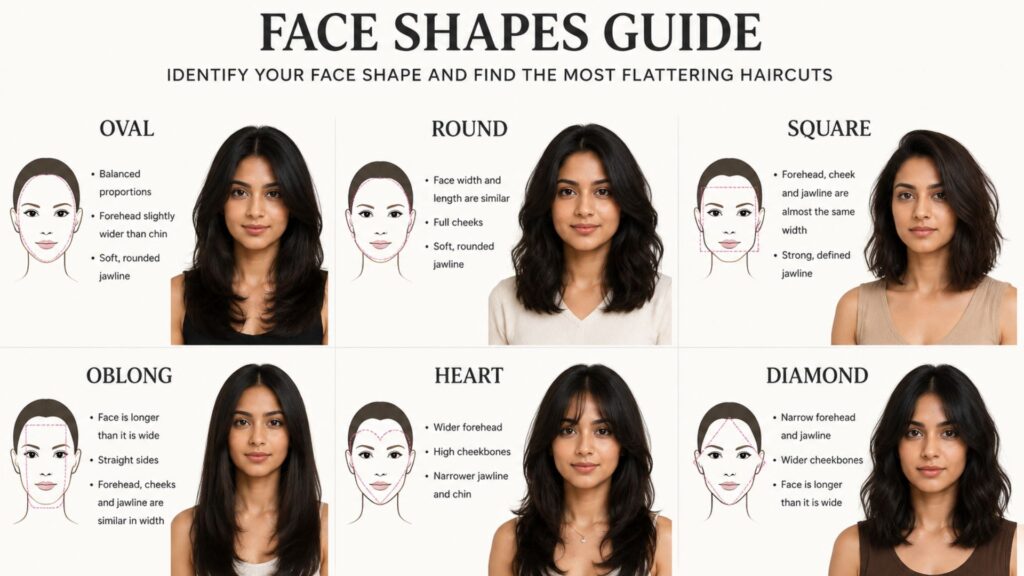
Before choosing a haircut, look at your face from the front with your hair pulled away from your face.
Consider:
- Width of your forehead
- Width of your cheekbones
- Width of your jaw
- Length of your face
- Shape of your chin
- Overall facial proportions
Most people broadly fall into one of these categories:
- Oval
- Round
- Square
- Oblong or long
- Heart
- Diamond
However, many faces don’t fit perfectly into one category.
You may have characteristics of two different shapes—and that’s completely normal.
Does Face Shape Really Matter When Choosing a Haircut?
Yes, but it shouldn’t dictate your haircut.
Face shape can help a stylist decide where to introduce:
- Length
- Width
- Layers
- Movement
- Volume
- Face-framing pieces
- Fringe
But your hair texture and density can be equally important.
For example, a layered haircut that looks soft and voluminous on naturally wavy hair may look completely different on fine, straight hair.
That’s why two women with similar face shapes may need different versions of the same haircut.
1. Best Haircuts for an Oval Face Shape
An oval face is generally characterized by balanced proportions, with the face being somewhat longer than it is wide.
Because the overall proportions are relatively balanced, many different haircut shapes can work.
Haircuts to consider
- Long layers
- Face-framing layers
- Lob
- Bob
- Medium-length cuts
- Long blunt cuts
- Curtain bangs
- Soft textured cuts
- Shoulder-length styles
If you have straight hair
A sleek bob or long layered haircut can create a polished appearance.
If you have wavy hair
Soft layers can enhance your natural movement.
If you have curly hair
A shape designed around your natural curl pattern can work beautifully.
The important point
Having an oval face doesn’t mean every haircut will automatically suit you.
Your hair density and natural texture still determine how the cut will behave.
2. Best Haircuts for a Round Face Shape
A round face generally has softer contours, with the width and length appearing relatively similar.
If you’d like to create the appearance of additional length or definition, your stylist may consider haircuts that introduce vertical movement and strategic face framing.
Haircuts to consider
- Long layers
- Longer face-framing layers
- Long bob
- Angled bob
- Side-swept fringe
- Long textured hair
- Shoulder-length layered cuts
What to discuss with your stylist
Instead of simply saying:
“I have a round face. Give me a slimming haircut.”
Try:
“I’d like a haircut that gives my face more definition while working with my natural hair texture.”
That’s a much more useful starting point for a professional consultation.
Don’t feel you have to hide your face shape
A round face can look beautiful with short hair, medium hair or long hair.
The goal isn’t to make your face look like another shape.
It’s to create a haircut you feel confident wearing.
3. Best Haircuts for a Square Face Shape
A square face often has a more defined jawline and relatively similar forehead, cheekbone and jaw widths.
You can either emphasize that strong structure or soften the overall appearance with movement.
Haircuts to consider
- Long layers
- Soft face framing
- Textured lob
- Shoulder-length cuts
- Soft waves
- Curtain fringe
- Long layered styles
Want a softer look?
Ask your stylist about:
Face-framing layers + soft movement
rather than creating very sharp lines around the jaw.
Want a stronger look?
A structured bob or clean blunt cut can emphasize the architectural quality of a stronger jawline.
Both approaches can work.
4. Best Haircuts for a Long or Oblong Face Shape
A long or oblong face generally has greater length relative to its width.
If you’d like to create the appearance of more width and balance, your stylist may use:
- Medium-length cuts
- Shoulder-length styles
- Layers around the face
- Curtain bangs
- Side-swept fringe
- Soft waves
- Volume around the sides
A useful principle
Where the volume sits can change the overall visual balance of a haircut.
For example, adding movement around the cheekbone or jaw area can create a different effect from keeping all the volume concentrated at the crown.
5. Best Haircuts for a Heart-Shaped Face
A heart-shaped face typically has a wider upper face and a narrower lower face.
Haircuts that introduce movement around the lower portion of the face can create a balanced silhouette.
Haircuts to consider
- Chin-length bob
- Long layers
- Curtain bangs
- Side-swept fringe
- Face-framing layers
- Medium-length waves
- Shoulder-length cuts
One particularly useful approach
Ask your stylist to consider where the face-framing layers begin.
A layer starting near the cheekbone will create a very different effect from one beginning around the chin.
6. Best Haircuts for a Diamond Face Shape
A diamond-shaped face often has more prominent cheekbones with a comparatively narrower forehead and jawline.
The haircut can be used to complement the cheekbones while creating balance around the forehead and jaw.
Options to explore
- Side-swept fringe
- Chin-length styles
- Soft layers
- Face framing
- Medium-length cuts
- Long textured styles
- Soft waves
Again, the exact placement of the layers matters more than simply choosing a haircut name.
Face Shape Haircut Guide at a Glance
| Face Shape | Haircut Directions to Explore |
|---|---|
| Oval | Bob, lob, layers, long cuts, face framing |
| Round | Long layers, longer face framing, angled lob |
| Square | Soft layers, textured lob, waves, face framing |
| Long/Oblong | Medium lengths, side fringe, curtain bangs, side volume |
| Heart | Chin-length cuts, curtain bangs, long layers |
| Diamond | Side fringe, face framing, chin-length styles, soft layers |
Remember: These are starting points, not strict rules.
Face Shape Is Only One Part of the Haircut Decision
This is where many haircut guides oversimplify the process.
Your face shape might suggest a particular haircut—but your hair may tell your stylist to modify it.
Before deciding on a haircut, consider these five additional factors.
1. Hair Texture
Is your hair:
- Straight?
- Wavy?
- Curly?
- Coily?
Texture changes the way layers, fringe and length behave.
A haircut designed for straight hair may need significant modification for curly hair.
2. Hair Density
Do you have:
- Fine, lower-density hair?
- Medium-density hair?
- Thick, dense hair?
Density affects how much weight the haircut needs to retain or remove.
For example, excessive layering may not produce the desired effect on some fine hair, while thick hair may benefit from strategic weight distribution.
3. Hair Length
The same face-framing technique can look completely different on:
Short hair → Medium hair → Long hair
Don’t choose a haircut solely because it suits your face shape.
Decide how much length you’re realistically comfortable losing.
4. Hair Condition
Consider whether your hair is:
- Natural
- Coloured
- Highlighted
- Bleached
- Chemically treated
- Heat damaged
- Dry or fragile
The condition of the ends may influence the final haircut and how much length your stylist recommends removing.
5. Lifestyle
This is one of the most overlooked factors.
Ask yourself:
Do I style my hair every day?
Do I usually air-dry it?
Do I exercise frequently?
Do I wear my hair tied up?
How often am I willing to visit the salon?
Am I comfortable using heat tools?
A haircut that looks fantastic after 45 minutes of professional styling may not be the best choice if you have five minutes every morning.
How to Choose a Haircut If You Have Indian Hair
There is no single “Indian hair type.”
Indian women have a wide variety of:
- Straight hair
- Wavy hair
- Curly hair
- Fine hair
- Thick hair
- High-density hair
- Chemically treated hair
Climate and lifestyle can also influence how hair behaves.
For example, humidity can make some hair textures appear more voluminous or frizzy, while heat styling and chemical services can change the condition and behaviour of the hair.
So instead of asking:
“Which haircut is best for Indian women?”
a better question is:
“Which haircut works best for my Indian hair texture, density, face proportions and lifestyle?”
How to Choose Layers for Your Face Shape
Layers aren’t simply “long” or “short.”
Their starting point matters.
For example:
Layers beginning around the cheekbones
Can draw attention toward the upper face.
Layers beginning around the jaw
Can introduce movement around the lower face.
Long layers beginning below the shoulders
Can create movement while preserving more weight and length.
That’s why you should show your stylist a reference photo and explain what you like about it.
What About Curtain Bangs?
Curtain bangs are popular because they can be adapted to many different face shapes.
But the length and parting matter.
You might prefer:
- Shorter curtain bangs
- Long curtain fringe
- Soft face-framing pieces
- Blended fringe
- A longer grown-out version
If you’re nervous about committing to bangs, ask your stylist about a longer, softer version that can blend into face-framing layers.
How to Use a Celebrity or Pinterest Haircut Reference
Don’t simply show a picture and say:
“I want this exact haircut.”
Instead, explain:
“I like the layers.”
“I like the movement around the face.”
“I like the length.”
“I don’t want short layers.”
“I want something I can air-dry.”
“I want to keep my ponytail.”
This helps your stylist translate the inspiration into a haircut that works for your hair.
7 Questions to Ask Your Hairstylist
Before your haircut, ask:
- Does this haircut work with my natural texture?
- Where should my shortest layer start?
- How much length will I lose?
- Will I need daily styling?
- Can I still tie my hair up?
- How will this haircut grow out?
- How often will I need a maintenance trim?
These questions can prevent the common problem of loving the haircut in the salon but struggling to recreate it at home.
The Most Important Rule: Don’t Follow Face-Shape Rules Too Literally
Face-shape guides are useful because they help you understand proportion and balance.
But they shouldn’t make you feel that certain haircuts are “forbidden.”
A woman with a round face can absolutely wear a bob.
A woman with a long face can wear long hair.
A woman with a square face can wear a blunt cut.
A woman with an oval face can choose almost any haircut—but still needs the right version for her texture and lifestyle.
The best haircut is the one that brings all the factors together.
Face shape + hair texture + density + condition + length + lifestyle + personal style
When You Should Get Professional Haircut Advice
Consider a professional consultation if:
- You’re making a major length change
- You’re unsure about your face shape
- You have very thick or very fine hair
- You have curly or highly textured hair
- Your hair has been heavily chemically treated
- You want bangs
- You’re combining a haircut with colour
- You want a low-maintenance style
- Your reference haircut looks very different from your natural hair
A professional can assess your hair in its natural state and adapt the haircut rather than simply copying an image.
Your Haircut Consultation at Kapil’s Salon
At Kapil’s Salon, the haircut consultation should be about more than selecting a picture from a catalogue.
Your stylist can consider:
Your face proportions
↓
Natural hair texture
↓
Hair density
↓
Current length
↓
Hair condition
↓
Lifestyle & styling habits
↓
Your desired look
↓
The haircut shape
The goal is to create a haircut that looks good in the salon and in your everyday life.
Frequently Asked Questions
What is the best haircut for my face shape?
There isn’t one universally best haircut for each face shape. The right choice depends on your face proportions as well as your hair texture, density, length and lifestyle.
Which haircut is best for a round face?
Longer layers, strategic face framing, longer bobs and angled shapes are options to discuss with your stylist. The best version depends on your hair texture and desired look.
Which haircut is best for an oval face?
Oval faces can work with many haircut shapes, including bobs, lobs, layers, long cuts and face-framing styles. Hair texture and density should still guide the final choice.
Which haircut is best for a square face?
Soft layers, face framing, textured lobs and waves can complement a defined jawline. A structured haircut can also work if you want to emphasize your natural features.
What haircut suits a long face?
Medium-length cuts, layers, curtain bangs, side-swept fringe and movement around the sides can help create visual balance.
What haircut suits a heart-shaped face?
Chin-length cuts, curtain bangs, long layers and face-framing styles are options worth discussing with a professional stylist.
Does face shape determine the haircut I should get?
No. Face shape is only one consideration. Hair texture, density, condition, lifestyle and personal preference are equally important.
Can I have short hair with a round face?
Absolutely. Face shape doesn’t prohibit a particular haircut. The shape, length, volume and styling can be customized to create the look you want.
Should I choose my haircut based on a celebrity?
Use celebrity or social-media photographs as inspiration rather than an exact template. Your stylist can adapt the concept to your hair and facial proportions.
Can a haircut change my face shape?
A haircut cannot physically change your facial structure, but its length, layers, volume and framing can change how your facial proportions are visually perceived.
Final Takeaway
Don’t choose your next haircut based on face shape alone.
Use face shape as your starting point, then consider:
Face shape
- Hair texture
- Hair density
- Hair length
- Hair condition
- Lifestyle
- Maintenance preference
That’s the difference between simply copying a haircut and choosing a haircut that is actually designed for you.
Ready to find your next haircut?
Book a professional haircut consultation at Kapil’s Salon and discuss your face shape, natural hair texture, desired length and lifestyle with a trained hairstylist before making the cut.