
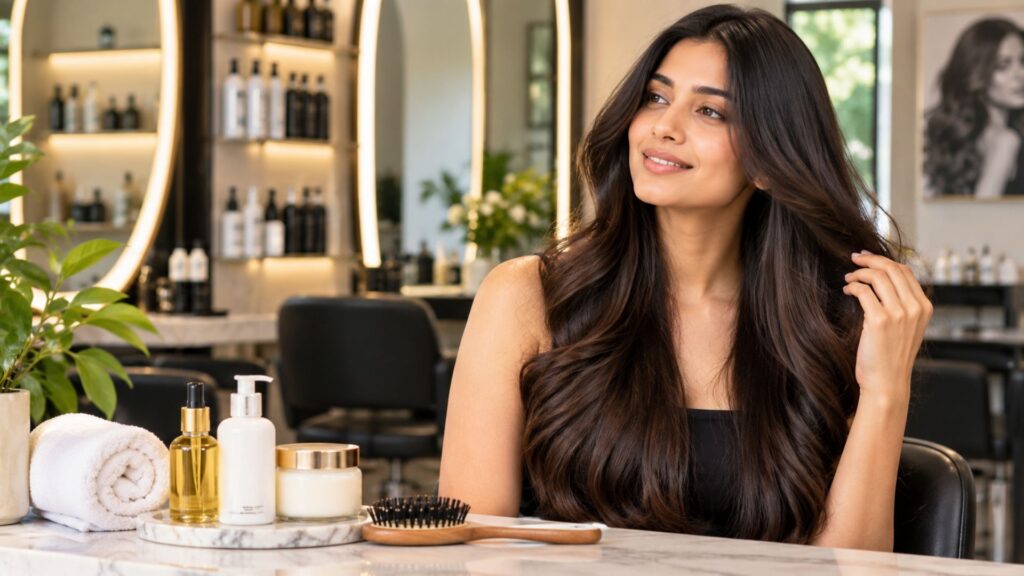
Indian hair is diverse. It can be straight, wavy, curly, coarse, fine, dry, oily or chemically treated—and the right routine depends more on hair and scalp condition than on nationality alone.
A good Indian hair-care routine starts with understanding your scalp, hair texture, porosity, chemical history and lifestyle. From choosing the right shampoo and conditioner to managing frizz, hair fall, dandruff, colour-treated hair and monsoon humidity, small changes can make a significant difference.
At Kapil’s Salon, professional hair consultations focus on understanding the individual’s hair and scalp before recommending a service or routine.
Quick Answer: What Is the Best Hair Care Routine for Indian Hair?
A simple routine is:
1. Identify your scalp type → 2. Choose a suitable shampoo → 3. Condition the lengths → 4. Use a hair mask when needed → 5. Protect hair from heat → 6. Manage chemical treatments carefully → 7. Maintain regular trims → 8. Adjust your routine according to weather and hair condition.
There is no single shampoo, oil or treatment that is best for everyone.
1. Why Does Indian Hair Need a Different Approach?
India has a wide range of:
- climates
- humidity levels
- water qualities
- hair textures
- lifestyles
- styling habits
- colouring and chemical-treatment practices
Mumbai’s humidity, Delhi’s dry climate, Bengaluru’s weather and coastal environments can all affect how hair behaves.
However, “Indian hair” is not one hair type.
Two people living in the same city can have completely different:
- scalp conditions
- curl patterns
- hair density
- strand thickness
- porosity
- damage levels
Therefore, your routine should be based on your actual hair characteristics, not simply your location.
2. First Identify Your Scalp Type
Your scalp determines many of your hair-care decisions.
Oily scalp
You may notice:
- greasy roots
- frequent need to shampoo
- buildup
- flat-looking hair
Dry scalp
Possible signs include:
- tightness
- visible flaking
- discomfort
- dryness
Combination scalp
Your roots may become oily while your lengths remain dry.
Sensitive scalp
You may experience irritation or discomfort with certain products.
Important: persistent itching, severe scaling, sudden hair loss or scalp inflammation should be evaluated by an appropriate healthcare professional rather than treated solely as a salon issue.
3. Understand Your Hair Texture
Hair can broadly be:
Straight
Usually lies relatively flat and may show oiliness more quickly at the roots.
Wavy
Has a natural S-shaped pattern and may become frizzy with humidity.
Curly
Requires careful moisture management and gentle handling.
Coily
Often benefits from careful detangling, conditioning and moisture retention.
Your routine should change according to your texture.
4. How Often Should You Wash Your Hair?
There is no universal number of washes per week.
Consider:
- scalp oiliness
- exercise
- sweating
- pollution
- product buildup
- hair texture
- dandruff or scalp conditions
Someone with an oily scalp may need more frequent washing than someone with a dry scalp.
The goal isn’t to follow a fixed schedule.
The goal is to keep the scalp clean and comfortable without unnecessarily drying the hair lengths.
5. How to Shampoo Correctly
A common mistake is aggressively scrubbing the entire length of the hair.
Instead:
Step 1
Wet your hair thoroughly.
Step 2
Apply shampoo primarily to the scalp.
Step 3
Massage gently using your fingertips.
Step 4
Allow the foam to cleanse the lengths as it rinses.
Step 5
Rinse thoroughly.
Step 6
Condition the mid-lengths and ends.
6. How to Choose the Right Shampoo
Don’t choose shampoo simply because it says:
“For Indian Hair.”
Look at your actual needs.
Oily scalp
Prioritize appropriate cleansing.
Dry hair
Look for a gentler cleansing routine.
Coloured hair
Consider products designed for colour-treated hair.
Curly hair
Focus on maintaining moisture and minimizing unnecessary dryness.
Damaged hair
A professional assessment can help determine whether your hair needs conditioning, bond-supporting care or a different routine.
7. Conditioner Is Not Optional for Many Hair Types
Shampoo cleanses.
Conditioner helps improve the feel, manageability and detangling of the hair.
Apply conditioner mainly to:
mid-lengths → ends
rather than heavily coating the scalp.
Leave it according to the product instructions and rinse thoroughly.
8. Hair Mask vs Conditioner
They are not necessarily interchangeable.
Conditioner
Designed for regular use and easier detangling.
Hair mask
Usually provides a more intensive conditioning experience and may be useful for particularly dry, rough or damaged hair.
A hair mask can complement—not automatically replace—your regular conditioner.
9. Does Hair Oiling Actually Help?
Hair oiling is deeply established in Indian hair-care culture.
But it should not be treated as a universal cure for:
- hair loss
- dandruff
- baldness
- scalp disease
Oil can help improve the feel and manageability of some hair types and may reduce friction during grooming.
But more oil does not automatically mean healthier hair.
If you have dandruff, an oily scalp or scalp irritation, heavy oiling may not be appropriate for you.
10. Hair Fall vs Hair Breakage
This is one of the most important distinctions.
Hair fall
The hair is shed from the scalp.
Hair breakage
The hair shaft breaks somewhere along its length.
Signs of breakage can include:
- shorter broken strands
- split ends
- uneven lengths
- increased breakage while brushing
If you notice sudden, severe or persistent hair loss, consult a dermatologist or other qualified healthcare professional.
A salon can help with hair appearance, grooming and hair-care practices, but it should not replace medical diagnosis.
11. How to Reduce Hair Breakage
Focus on:
- gentle detangling
- minimizing excessive heat
- avoiding unnecessarily tight hairstyles
- conditioning regularly
- reducing repeated chemical processing
- using appropriate heat protection
- trimming damaged ends when necessary
12. Indian Hair and Humidity
Humidity can make hair appear:
- frizzy
- puffy
- less defined
- difficult to style
This is particularly noticeable during monsoon in many parts of India.
A useful humidity routine can include:
gentle cleansing + conditioning + leave-in/serum where appropriate + heat protection + controlled styling
Avoid repeatedly applying heavy products simply to suppress frizz.
13. Hair Care During Indian Monsoon
During humid weather:
Do
- Keep the scalp clean.
- Dry hair properly after getting wet.
- Avoid going to bed with soaking-wet hair.
- Cleanse according to your scalp needs.
- Manage product buildup.
- Protect hair from excessive heat.
Don’t
- Over-oil an already oily scalp.
- Leave sweaty scalp uncleaned for prolonged periods.
- Aggressively brush wet hair.
- Continuously use high heat to control frizz.
14. Hair Care During Summer
Indian summers can mean:
- sweat
- UV exposure
- dust
- frequent washing
- swimming
Your routine may need adjustment.
If you swim regularly, pay particular attention to cleansing and conditioning appropriate for your hair.
15. Hair Care During Winter
In drier weather, some people notice:
- roughness
- dryness
- static
- increased scalp discomfort
Focus on:
- appropriate conditioning
- gentle cleansing
- avoiding excessive hot-water exposure
- protecting hair from unnecessary heat
16. Hair Colour Changes Your Hair-Care Routine
If you colour your hair, your routine should change.
Consider:
- colour-safe cleansing
- regular conditioning
- heat protection
- avoiding unnecessary repeated chemical processing
- professional colour maintenance
For lightening, bleaching or major colour changes, professional consultation is particularly important.
17. Hair Care After Keratin or Smoothening
After a professional smoothing service, follow the specific aftercare instructions provided by your stylist.
Depending on the treatment, your routine may include:
- recommended cleansing products
- conditioning
- heat protection
- controlled styling
- scheduled maintenance
Don’t assume that the same routine works for every keratin, smoothening or straightening service.
18. How Often Should You Trim Your Hair?
There isn’t one scientifically required interval that applies to everyone.
Your ideal trimming schedule depends on:
- haircut shape
- hair growth goals
- split ends
- styling needs
- chemical processing
- hair condition
If you’re growing your hair, trimming does not make hair grow faster from the scalp.
It can, however, help manage damaged or split ends and maintain the shape of a haircut.
19. Night-Time Hair Care
Before bed:
- Detangle gently if needed.
- Avoid sleeping with soaking-wet hair.
- Avoid excessively tight hairstyles.
- Keep your scalp comfortable.
- Protect fragile or curly hair according to its needs.
Your routine should be simple enough that you can follow it consistently.
20. A Simple Indian Hair-Care Routine
DAILY
- Handle hair gently.
- Protect from excessive heat.
- Avoid unnecessarily tight hairstyles.
- Use serum/leave-in products where appropriate.
WASH DAY
Shampoo → Condition → Gentle towel drying → Leave-in/serum if needed
WEEKLY
Assess:
- scalp condition
- dryness
- frizz
- buildup
- breakage
Use a hair mask if appropriate for your hair.
MONTHLY
Consider:
- haircut/trim
- professional consultation
- colour maintenance
- treatment assessment
The exact schedule should depend on your hair.
21. When Should You See a Professional?
Consider a professional hair consultation when:
- your hair suddenly changes
- you’re experiencing significant breakage
- you want to change hair colour dramatically
- you’re considering chemical treatments
- your hair feels severely damaged
- you don’t know your hair type
- you’re unsure which salon treatment is appropriate
A consultation can help determine whether you need a haircut, colour service, conditioning treatment, scalp-focused service or simply a better home-care routine.
22. When Should You See a Dermatologist?
A salon should not be positioned as a substitute for medical care.
Seek professional medical evaluation for concerns such as:
- sudden significant hair loss
- bald patches
- persistent scalp inflammation
- severe itching
- unexplained scalp lesions
- rapidly worsening thinning
- persistent dandruff that doesn’t improve with appropriate care
23. The Kapil’s Salon Hair Consultation Approach
At Kapil’s Salon,it begin with the individual’s hair rather than immediately recommending a treatment.
consultation flow:
Scalp → Texture → Density → Condition → Chemical history → Lifestyle → Styling habits → Desired result
Only then our stylist recommend an appropriate service or home-care routine.
24. Common Hair-Care Mistakes
Mistake 1
Following someone else’s routine blindly.
Mistake 2
Using too much oil.
Mistake 3
Applying conditioner heavily to the scalp.
Mistake 4
Using high heat without protection.
Mistake 5
Repeatedly colouring already compromised hair.
Mistake 6
Aggressively brushing wet hair.
Mistake 7
Ignoring scalp problems.
Mistake 8
Assuming expensive products automatically work better.
Mistake 9
Treating hair fall as purely a cosmetic issue.
Mistake 10
Choosing salon treatments without a proper consultation.
25. Quick Hair-Care Checklist
Know your:
- Hair texture
- Scalp type
- Hair density
- Hair condition
- Chemical history
- Styling habits
Then build your:
- Shampoo routine
- Conditioning routine
- Treatment routine
- Heat-protection routine
- Colour-care routine
- Seasonal routine
Frequently Asked Questions
How often should I wash Indian hair?
There is no universal frequency. Wash according to scalp oiliness, activity, sweat, product buildup and hair condition.
Is oiling necessary for healthy hair?
Not necessarily. Hair oiling can be part of a routine for some people, but it isn’t required for everyone and isn’t a cure for hair loss or scalp disease.
Is hair spa good for Indian hair?
It can help improve the feel, conditioning and manageability of some hair types. The appropriate treatment depends on the hair’s condition and goals.
Is keratin good for frizzy Indian hair?
Keratin-based professional treatments may reduce frizz and make styling easier for suitable candidates. A professional assessment is recommended before treatment.
How can I control frizz during monsoon?
Focus on appropriate cleansing, conditioning, leave-in care, heat protection and controlled styling rather than repeatedly applying heavy products.
Is hair fall normal?
Some daily shedding is normal, but significant, sudden or persistent hair loss warrants professional medical evaluation.
How can I protect coloured hair?
Use appropriate colour-care products, condition regularly, protect against excessive heat and follow your colourist’s maintenance recommendations.
How often should I get a haircut?
It depends on your haircut, hair condition and goals. Short styles generally need more frequent maintenance than long styles.
Is hair oil good for dandruff?
Not necessarily. Dandruff has different causes and heavy oiling isn’t an appropriate solution for everyone.
What is the best hair-care routine?
There is no universal “best” routine. The right routine depends on your scalp, texture, density, condition, chemical history and lifestyle.