

You oil your hair. You shampoo it. You condition it. You use serums, masks and styling products.
Yet your hair may still feel dry, frizzy, weak, tangled or difficult to manage.
So what are you doing wrong?
The problem may not be the lack of hair-care products. It may be the habits surrounding how you wash, dry, style, colour and maintain your hair.
Hair-care needs vary according to hair texture, scalp condition, chemical treatments, styling habits and environment. Dermatologists also emphasize that certain everyday practices can make hair brittle, frizzy, lacklustre and more prone to breakage.
For Indian women, hair care can be particularly challenging because routines often combine oil treatments, frequent washing, heat styling, colouring, straightening, long hair, tight hairstyles and exposure to heat, humidity and pollution.
Here are 15 common hair-care mistakes to stop making—and what to do instead.
1. Shampooing Your Entire Hair Aggressively
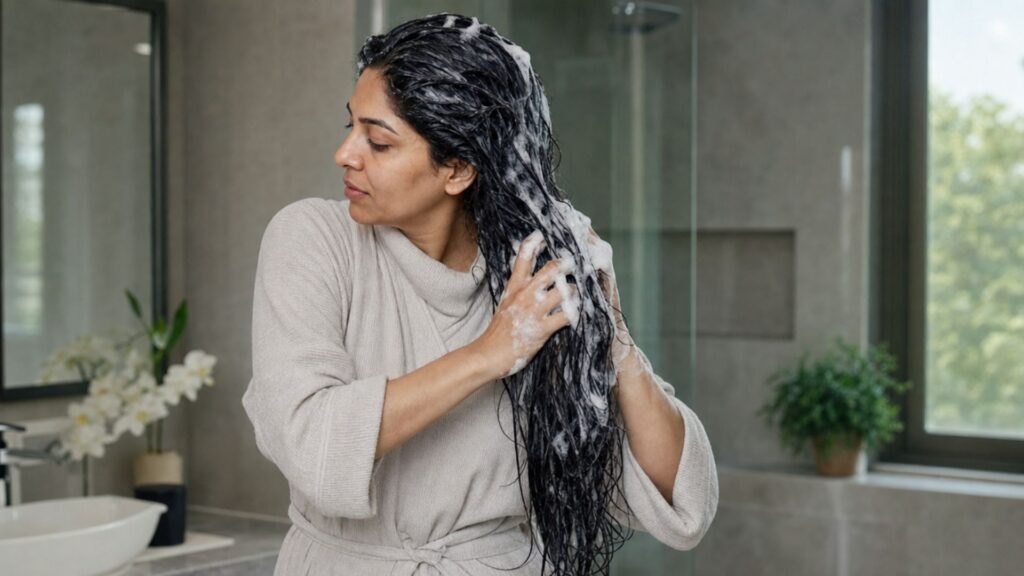
One of the most common mistakes is applying shampoo from the roots all the way to the ends and vigorously rubbing the entire length.
Your scalp produces oil, sweat and buildup. Your lengths generally need a gentler approach.
Instead:
Focus shampoo on the scalp and roots.
Massage gently with your fingertips and allow the shampoo to rinse through the lengths.
The American Academy of Dermatology recommends applying shampoo primarily to the scalp rather than rubbing it through the entire length of the hair.
Remember:
Clean the scalp. Protect the lengths.
2. Washing Your Hair According to a Fixed Schedule
“Wash your hair twice a week.”
“Never wash your hair every day.”
“Only wash your hair once a week.”
You’ve probably heard all three.
The truth is that there is no single washing schedule that works for every woman.
Your ideal frequency depends on:
- scalp oiliness
- hair texture
- activity level
- sweat
- styling products
- environmental exposure
- chemical treatments
Instead:
Pay attention to your scalp, not somebody else’s schedule.
An oily scalp may need more frequent cleansing, while dry, curly or textured hair may require less frequent shampooing.
3. Skipping Conditioner Because Your Hair Is “Already Oily”
This is a common misunderstanding.
Having an oily scalp doesn’t necessarily mean your hair lengths don’t need conditioning.
In fact, you can have:
Oily roots + dry ends
Instead:
Condition according to where your hair needs it.
For many hair types, concentrate conditioner through the mid-lengths and ends.
If your hair is dry or curly, you may need conditioning throughout more of the length.
4. Rubbing Your Hair Aggressively With a Towel
This habit feels harmless.
It isn’t ideal for fragile, wet hair.
Vigorously rubbing wet hair can create unnecessary friction and contribute to breakage.
Instead:
Gently squeeze → wrap → blot
A soft towel or T-shirt can be used to absorb excess water without aggressively rubbing the hair.
5. Brushing Wet Hair Aggressively
Wet hair needs careful handling.
Dragging a brush through a tangled mass from roots to ends can create unnecessary pulling.
Better technique:
Start at the ends.
Then gradually work upward:
Ends → Mid-lengths → Roots
For curly or textured hair, a wide-tooth comb and appropriate detangling technique can be useful.
The best approach depends on your hair texture.
6. Using Heat Every Day
Straightener today.
Blow-dry tomorrow.
Curling iron the next day.
Then repeat.
If your hair is already dry, frizzy or chemically treated, frequent high-heat styling can add more stress.
The AAD recommends limiting heat styling and using lower or medium heat settings where possible.
Instead:
Give your hair heat-free days.
And when you do use heat:
Heat protectant + moderate temperature + minimal passes.
7. Thinking Heat Protectant Makes Any Amount of Heat Safe
Heat protectant is useful.
But it isn’t an invisible shield.
Using a heat protectant doesn’t mean you can repeatedly use a straightener at maximum temperature without consequences.
Instead:
Think:
Protect + Reduce + Control
Use protection.
Reduce frequency.
Control temperature.
And avoid repeatedly passing the tool over the same section.
8. Keeping Tight Hairstyles on All Day
Sleek ponytails and tight buns can look fantastic.
But constantly pulling hair tightly—especially around the hairline—can place stress on the hair and follicles.
Repeated pulling can contribute to traction alopecia, a type of hair loss caused by prolonged tension. In some cases, the damage can become permanent.
Warning sign:
If your hairstyle hurts, it’s too tight.
Instead:
Rotate hairstyles.
Give your hairline breaks.
Avoid constantly pulling the same areas.
9. Wearing Extensions Without Giving Your Hair a Break
Extensions can instantly add:
- length
- volume
- colour
- styling options
But they also add weight and tension.
The AAD warns that extensions and weaves can contribute to breakage and hair loss when they create repeated pulling or excessive tension.
Instead:
- Have them professionally fitted.
- Avoid excessive tension.
- Monitor your hairline.
- Keep the natural hair clean and conditioned.
- Take breaks between installations.
10. Treating Hair Colour Like It Has No Maintenance
Colouring can transform your look.
But chemical processing can also make hair more fragile, particularly when combined with bleaching or repeated processing.
Dermatologists note that colouring and perming can contribute to dry and brittle hair.
Instead:
After colouring:
Condition → Protect → Reduce heat → Maintain professionally
And avoid repeatedly overlapping chemical treatments onto already processed lengths unless recommended by a qualified professional.
11. Trying to Fix Damaged Hair With More and More Products
This is perhaps one of the biggest modern hair-care mistakes.
Your hair feels dry.
So you add:
Oil.
Mask.
Serum.
Leave-in.
Cream.
Spray.
Another mask.
Now your hair feels heavy.
The problem?
You’re treating the symptom without identifying the cause.
Dryness may be related to:
- heat damage
- chemical processing
- excessive cleansing
- environmental exposure
- mechanical damage
- naturally dry texture
Instead:
Ask:
Why is my hair dry?
Then build the routine around the answer.
12. Following Every Viral Hair Hack
Rice water.
Onion juice.
DIY masks.
Overnight oiling.
Random supplements.
Social-media hair hacks can be entertaining—but viral doesn’t automatically mean effective or suitable for your hair.
Instead:
Before trying a trend, ask:
What problem is it supposed to solve?
Is there evidence behind it?
Could it irritate my scalp or damage my hair?
Does it suit my hair type?
Your hair doesn’t need to participate in every internet trend.
13. Ignoring Your Scalp While Focusing Only on Your Hair
Many women spend hundreds of rupees on hair products while barely paying attention to the scalp.
But your scalp is where your hair grows.
Persistent:
- itching
- redness
- scaling
- painful areas
- unusual flaking
- sudden changes in shedding
shouldn’t simply be covered with styling products.
Instead:
Treat your scalp as part of your hair-care routine.
And if you have persistent scalp problems or significant hair loss, consult a dermatologist rather than attempting to diagnose the problem yourself.
14. Assuming Hair Fall Always Means You Need a Hair Treatment
Seeing hair in your comb or shower can be worrying.
But hair shedding and hair loss are not necessarily the same thing.
Hair shedding can be part of the normal hair cycle.
Hair loss can have many different causes, including medical and hormonal conditions.
Instead:
Look for patterns.
Ask:
- Is shedding suddenly increasing?
- Is my hair becoming visibly thinner?
- Are there bald patches?
- Is my parting becoming wider?
- Is my hairline changing?
- Is my scalp showing more than before?
If you notice significant or persistent hair loss, professional medical evaluation is more appropriate than simply booking another cosmetic treatment.
15. Believing One Hair Routine Works for Every Indian Woman
This might be the biggest mistake of all.
Your friend may wash her hair every day.
Your sister may oil it twice a week.
Your colleague may have curly hair and wash it once a week.
None of that automatically tells you what your hair needs.
Indian women can have dramatically different:
- hair textures
- scalp types
- hair densities
- curl patterns
- chemical histories
- lengths
- styling habits
Instead:
Build your routine around your hair.
The 5 Biggest Hair-Care Rules to Remember
If you don’t remember all 15 mistakes, remember these five:
1. Know your scalp.
Your scalp determines much of your cleansing routine.
2. Know your hair texture.
Straight, wavy, curly and coily hair don’t behave identically.
3. Reduce unnecessary damage.
Heat, chemicals, friction and tension can accumulate.
4. Condition intelligently.
Don’t just buy a conditioner—use it where your hair needs it.
5. Investigate persistent problems.
Hair breakage is different from hair loss.
Scalp irritation is different from ordinary dryness.
And cosmetic hair care isn’t a substitute for medical diagnosis.
A Simple Hair-Care Routine for Indian Women
Wash Day
1. Pre-wash preparation
Optional, depending on hair type and routine.
↓
2. Shampoo
Focus primarily on the scalp.
↓
3. Conditioner
Apply according to hair texture and dryness.
↓
4. Gentle detangling
Avoid aggressive pulling.
↓
5. Gentle drying
Blot instead of rubbing.
↓
6. Leave-in/serum
If appropriate for your hair.
↓
7. Heat protection
Before heat styling.
What About Hair Oiling?
Hair oiling is an important part of many Indian hair-care routines.
But more oil isn’t necessarily better.
Some people may find oiling the lengths useful for improving softness and reducing friction. But applying heavy oils to the scalp isn’t appropriate for everyone, particularly people with certain scalp conditions.
The smarter approach:
Use oil according to your hair and scalp needs—not simply because it’s traditional.
What About Hair Spa Treatments?
A professional hair treatment can help improve the feel, softness, manageability and appearance of hair depending on its condition and the treatment used.
But don’t think of a hair spa as a cure for every hair problem.
If you’re dealing with:
- significant hair loss
- bald patches
- persistent scalp irritation
- sudden thinning
- severe scaling
you may need a dermatologist rather than a cosmetic treatment.
Kapil’s Salon Expert Tip
Don’t ask, “Which product should I buy?” first. Ask, “What is happening to my hair?”
At Kapil’s Salon, a professional hair consultation can help assess visible factors such as:
Hair texture
Dryness
Frizz
Breakage
Chemical history
Heat-styling habits
Hair length
Scalp condition
From there, your salon professional can recommend an appropriate professional treatment and home-care routine.
For unexplained or persistent hair loss or scalp symptoms, consult a dermatologist.
Frequently Asked Questions
What are the most common hair-care mistakes Indian women make?
Common mistakes include excessive heat styling, aggressive towel drying, improper shampoo application, skipping conditioner, tight hairstyles, over-processing with colour or chemical treatments, aggressive detangling and following unsuitable viral hair-care trends.
Does washing hair frequently cause hair fall?
Not necessarily. Washing can make already-shed hairs more visible in the shower, but the appropriate washing frequency depends on your scalp and hair type. Hair loss has many possible causes and should not automatically be attributed to shampooing.
Should I shampoo my hair lengths?
Generally, shampoo should be concentrated primarily on the scalp. The lather running through the lengths during rinsing is often sufficient for cleansing them.
Is tight ponytail bad for hair?
Repeatedly wearing very tight hairstyles can place tension on the hair and follicles and may contribute to traction alopecia. If a hairstyle causes pain or persistent pulling, loosen it.
Is daily straightening bad for hair?
Frequent heat styling can contribute to hair damage. Reducing frequency and using lower temperatures can help minimize damage.
Should I brush my hair when it is wet?
It depends on your hair type and the detangling method. Wet hair should be handled gently. Curly or textured hair may benefit from careful damp detangling with an appropriate wide-tooth comb, while aggressive brushing should be avoided.
Can hair oil stop hair fall?
Hair oil should not be presented as a universal treatment for hair loss. Hair loss can have many causes, and persistent or significant loss should be professionally evaluated.
How often should I get a hair spa?
There is no universal frequency. It depends on your hair condition, chemical history, styling habits and the type of treatment being used. A professional assessment is more useful than following a fixed schedule.
Can damaged hair become healthy again?
Hair that has already been significantly damaged cannot simply be restored to its original structure. However, appropriate conditioning, reduced damage, careful handling and trimming of severely damaged ends can improve its appearance and manageability.
When should I see a dermatologist for hair loss?
See a dermatologist if you experience persistent or significant shedding, visible thinning, bald patches, scalp inflammation or other unusual changes. Finding the cause is an important part of effective hair-loss management.
Final Takeaway
You don’t need a complicated 20-step hair routine to have better hair.
You need to stop repeatedly damaging it.
Stop:
❌ Overwashing or under-cleansing without considering your scalp
❌ Aggressive towel drying
❌ Rough detangling
❌ Excessive heat
❌ Extremely tight hairstyles
❌ Unnecessary chemical processing
❌ Product overload
❌ Blindly following viral hacks
❌ Ignoring your scalp
❌ Assuming every instance of hair fall is the same
Start:
Understanding your hair → protecting it → conditioning it → reducing damage → getting professional advice when needed.
Because the best hair-care routine isn’t the one with the most products.
It’s the one your hair actually needs.