
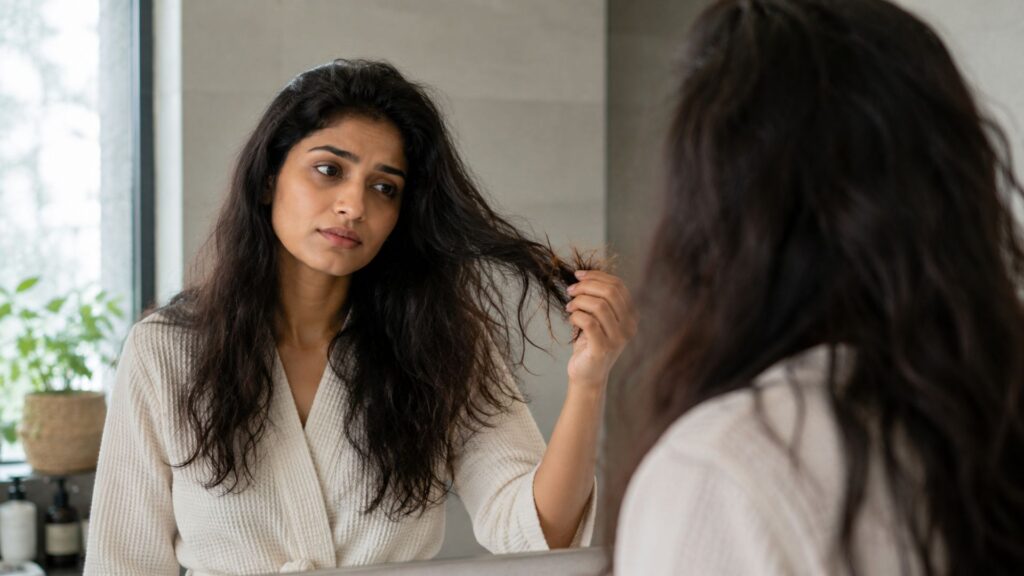
Best Hair Care Routine for Dry, Frizzy Hair
Does your hair feel dry, rough, tangled and impossible to control—especially in India’s humidity?
You’re not alone.
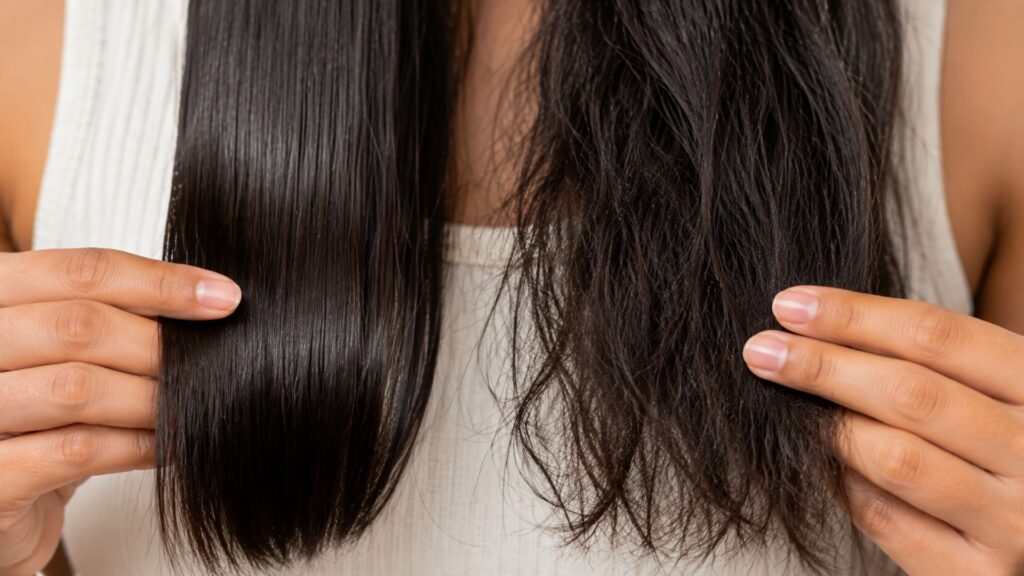
Dryness and frizz often go together because hair that has lost moisture or has a damaged outer layer can become rougher, more difficult to manage and more prone to breakage.
But here’s the important part:
Frizzy hair isn’t always a sign that your hair needs more products. It may need a better routine.
Your shampooing technique, conditioner, drying method, heat styling, chemical treatments, hair texture and even how you detangle your hair can all influence how dry and frizzy your hair looks.
The American Academy of Dermatology (AAD) recommends adapting hair care to your hair type, using conditioner after washing, handling wet hair gently and limiting excessive heat to reduce damage.
This guide explains how to build a practical dry and frizzy hair care routine for Indian hair.
Quick Answer: What Is the Best Routine for Dry, Frizzy Hair?
A simple routine looks like this:
Gentle shampoo → Moisturizing conditioner → Gentle drying → Careful detangling → Leave-in/serum if suitable → Heat protection → Regular deep conditioning → Minimize damage
You don’t necessarily need ten different products.
You need to consistently protect the hair from drying, friction, excessive heat and chemical damage.
Why Does Hair Become Dry and Frizzy?
Hair can become dry and frizzy for several reasons.
Common contributors include:
- Frequent washing
- Harsh cleansing
- Excessive heat styling
- Bleaching and colouring
- Chemical straightening
- Rough towel drying
- Excessive brushing
- Humidity
- Sun exposure
- Chlorine from swimming
- Split ends and existing hair damage
- Lack of conditioning
- Tight hairstyles and mechanical stress
The AAD notes that damaged hair is fragile and can become brittle, frizzy and more prone to breakage.
So if you’re constantly trying to “fix frizz” with styling products while continuing the practices causing damage, the problem can keep coming back.
Dry Hair vs Frizzy Hair: Are They the Same?
Not exactly.
Dry hair
Dry hair generally lacks sufficient moisture and may feel:
- rough
- brittle
- dull
- difficult to detangle
- prone to split ends
Frizzy hair
Frizz describes the appearance and behaviour of hair, where strands don’t lie smoothly together and may stick out or appear unruly.
You can have:
Dry + frizzy hair
But you can also have:
Oily roots + dry/frizzy lengths
This is particularly common with longer hair.
That’s why your scalp and your hair lengths should not necessarily receive the exact same treatment.
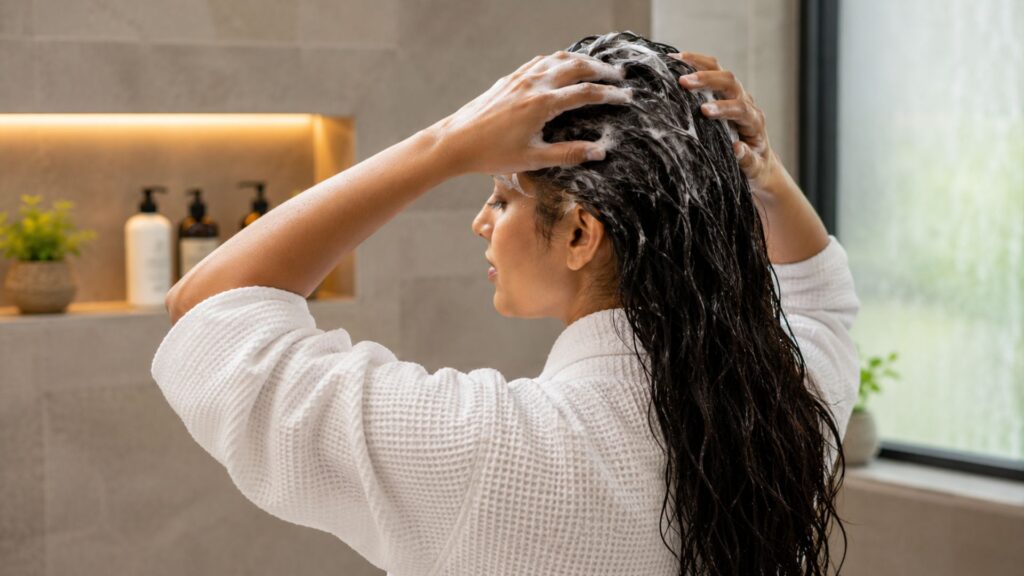
Step 1: Don’t Overwash Your Hair
If your hair is dry, washing more frequently than necessary may make the lengths feel even drier.
But that doesn’t mean you should avoid shampoo altogether.
The AAD recommends washing according to how oily or dirty your hair and scalp become. For dry, curly, textured or thick hair, washing when needed may be more appropriate than following a rigid daily schedule.
A useful rule:
Clean your scalp. Protect your lengths.
If your roots become oily quickly but your ends are dry, you may need to cleanse the scalp without aggressively shampooing the entire length.

Step 2: Shampoo the Scalp, Not the Lengths
This is one of the most important changes you can make.
Instead of rubbing shampoo aggressively through all your hair:
Do this:
- Wet your hair thoroughly.
- Apply shampoo primarily to the scalp.
- Massage gently with your fingertips.
- Rinse thoroughly.
- Allow the shampoo to flow through the lengths during rinsing.
The AAD specifically recommends applying shampoo to the scalp rather than the entire length to help remove oil and buildup without unnecessarily drying the hair.
Avoid:
❌ Aggressive scrubbing
❌ Scratching with fingernails
❌ Rubbing the lengths together
❌ Repeated shampooing without a reason
Step 3: Conditioner Is Not Optional for Dry Hair
If your hair is dry and frizzy, conditioning should be a core part of your routine.
Conditioner helps moisturize, smooth and detangle the hair.
The AAD recommends using conditioner after washing. For dry or curly hair, conditioner can be applied along the hair length rather than being limited only to the ends.
Apply conditioner:
Mid-lengths → Ends
If your hair is particularly dry or curly, you may need conditioning throughout the lengths.
Avoid:
Putting heavy conditioner directly onto an oily scalp unless the specific product is designed for scalp use.
Step 4: Don’t Rub Your Hair Dry
This is one of the easiest mistakes to fix.
After washing, many people vigorously rub their hair with a towel.
That creates friction.
And damaged hair is more vulnerable to breakage.
The AAD recommends wrapping hair in a towel or T-shirt to absorb moisture rather than aggressively rubbing it dry.
Better method:
Squeeze → Wrap → Gently press → Air dry or blow dry carefully
Not:
Rub → Twist → Pull
Step 5: Detangle Without Creating More Damage
Wet hair can be particularly vulnerable to mechanical damage.
For straight hair, the AAD recommends allowing hair to dry somewhat before gently combing it.
For thick, curly or textured hair, gentle detangling while damp—with a wide-tooth comb—may be appropriate.
Start at the ends.
Instead of dragging a comb from the roots to the ends:
Ends → Mid-lengths → Roots
This reduces unnecessary pulling through knots.
Step 6: Use a Leave-In Conditioner or Hair Serum
For dry, frizzy lengths, a leave-in conditioner or appropriate smoothing serum can make the hair easier to manage.
These products can help with:
- softness
- detangling
- smoothness
- appearance of frizz
- manageability
But remember:
A serum can improve the appearance and feel of damaged hair. It cannot permanently repair severely damaged hair.
Choose the product according to your hair type.
Fine hair
Use a lightweight product.
Thick/coarse hair
A richer leave-in or smoothing product may be more appropriate.
Curly hair
Look for products designed specifically for curl definition and moisture.
Step 7: Protect Your Hair From Heat
If you’re using:
- blow dryers
- straighteners
- curling irons
- hot brushes
heat protection should be part of the routine.
The AAD recommends limiting heat styling, allowing hair to partially air-dry when possible and using low or medium heat settings.
Better heat-styling routine:
Towel dry gently → Apply heat protectant → Partially air dry → Use low/medium heat → Finish
Don’t repeatedly pass a flat iron over the same section.
Step 8: Reduce the Number of Heat-Styling Sessions
A heat protectant isn’t permission to use maximum heat every day.
If your hair is already dry and frizzy, consider reducing:
- straightening
- curling
- high-temperature blow drying
- repeated heat exposure
The AAD notes that excessive heat can damage hair regardless of hair type.
Try this instead:
Give your natural texture some days off.
Your hair doesn’t need to be perfectly straight every day.
Step 9: Deep Conditioning Can Help Dry Hair
If your normal conditioner isn’t enough, consider adding a deep-conditioning or hair-mask step to your routine.
This can be particularly useful for:
- dry hair
- coarse hair
- long hair
- curly hair
- chemically treated hair
- heat-damaged hair
The exact frequency should depend on your hair’s condition and the product instructions.
A simple starting point:
Once a week
Then adjust depending on how your hair responds.
If your hair becomes heavy or greasy, reduce the frequency or use a lighter formula.
Step 10: What About Hair Oiling?
Hair oiling is deeply familiar in Indian hair-care culture, but it isn’t a universal solution for every scalp and hair type.
Some oils can help improve the feel and appearance of dry hair. Cleveland Clinic notes that certain oils may help moisturize hair and reduce the appearance of split ends temporarily, but suitability varies by hair type.
If you choose to oil:
Use a small amount and focus primarily on the lengths and ends if those are dry.
You don’t necessarily need to soak your scalp in oil.
And if you have a dandruff-prone or irritated scalp, speak with a dermatologist before making scalp oiling a regular routine. Cleveland Clinic specifically advises people prone to dandruff to avoid oiling the scalp.
Step 11: Protect Your Hair From the Sun
India’s strong sunlight can be another source of stress for your hair.
UV exposure can dry the hair and contribute to brittle, frizzy strands and split ends. Cleveland Clinic notes that prolonged UV exposure can damage the hair cuticle and structure.
When spending extended time outdoors:
- Wear a hat or scarf.
- Avoid unnecessary direct exposure.
- Use hair products with appropriate UV protection if suitable.
- Pay extra attention to coloured or bleached hair.
Step 12: Don’t Ignore Swimming
Swimming pools introduce another potential source of dryness.
Chlorine can be drying to hair.
Cleveland Clinic recommends wetting the hair before swimming, considering a swim cap, and rinsing the hair immediately afterward. A moisturizing conditioner can also help afterward.
Simple swimming routine:
Before swimming: Wet hair / use protective approach
↓
During: Swim cap if practical
↓
After: Rinse thoroughly
↓
Then: Shampoo if needed + moisturizing conditioner
Step 13: Get Regular Trims
If your ends are already severely split or damaged, products can temporarily improve their appearance—but they cannot permanently restore a split end.
A professional haircut can remove visibly damaged ends and help your hair look healthier and more even.
Think of trimming as:
Damage management—not hair growth treatment.
Cutting your hair doesn’t make the follicles grow faster.
Step 14: Be Careful With Chemical Treatments
Frequent:
- bleaching
- colouring
- straightening
- relaxing
- perming
can increase the risk of hair damage.
Cleveland Clinic notes that chemical processing can make hair more fragile and increase the likelihood of split ends and breakage.
That doesn’t mean you have to stop colouring your hair.
Instead:
Colour strategically → Maintain properly → Condition consistently → Reduce unnecessary additional damage
Step 15: Choose Your Routine Based on Your Hair Type
There isn’t one perfect routine for every Indian woman or man.
Fine + Dry Hair
Focus on:
- gentle shampoo
- lightweight conditioner
- lightweight leave-in
- minimal heavy oils
- low heat
Goal:
Moisture without weighing the hair down.
Thick + Dry Hair
Focus on:
- moisturizing shampoo
- rich conditioner
- regular deep conditioning
- leave-in products
- gentle detangling
Goal:
Moisture + manageability.
Curly Hair
Focus on:
- gentle cleansing
- generous conditioning
- curl-friendly leave-in
- minimal dry brushing
- controlled heat
Goal:
Moisture + curl definition + reduced breakage.
Chemically Treated Hair
Focus on:
- gentle cleansing
- intensive conditioning
- heat protection
- regular trims
- reduced additional chemical stress
Goal:
Protect the hair fibre from further damage.
Your Simple Weekly Routine for Dry, Frizzy Hair
Here’s a practical starting framework.
WASH DAY
1. Shampoo
Scalp-focused cleansing
2. Conditioner
Lengths and ends
3. Detangle
Gently with an appropriate comb
4. Dry
Blot/wrap instead of rubbing
5. Leave-in/serum
If suitable for your hair
6. Heat protectant
If using heat
BETWEEN WASHES
- Avoid unnecessary brushing.
- Minimize heat.
- Use a small amount of serum/leave-in if needed.
- Protect hair from excessive sun.
- Avoid tight hairstyles.
- Don’t repeatedly manipulate your hair.
ONCE A WEEK
Consider:
Deep-conditioning / hair mask
Adjust according to your hair’s needs.
EVERY FEW WEEKS / AS NEEDED
Review:
- split ends
- dryness
- colour damage
- heat damage
- scalp condition
A professional consultation can help determine whether your routine needs to change.
What Makes Indian Hair More Difficult to Manage?
It’s important not to assume that all Indian hair is the same.
Indian hair can be:
- fine
- thick
- straight
- wavy
- curly
- coarse
- chemically treated
- naturally dry
- oily at the scalp but dry at the ends
And India’s environment can add additional challenges:
Humidity
Can make hair appear more frizzy.
Heat
Can increase sweating and encourage frequent washing or styling.
Sun exposure
Can contribute to dryness and damage.
Pollution and dust
Can contribute to scalp and hair buildup.
Hard water in some regions
May affect how hair feels and how products perform.
Therefore:
The best Indian hair-care routine is personalized—not one-size-fits-all.
7 Things to Stop Doing If Your Hair Is Dry and Frizzy
1. Stop aggressively towel-drying.
2. Stop washing the lengths aggressively.
3. Stop using maximum heat.
4. Stop brushing excessively.
5. Stop repeatedly colouring or chemically processing already damaged hair.
6. Stop using heavy products just because your hair is dry.
7. Stop treating frizz without identifying the underlying cause.
The AAD specifically identifies excessive heat, rough handling, aggressive brushing, rubbing shampoo into the lengths and skipping conditioner among habits that can contribute to hair damage.
Can You Completely Get Rid of Frizzy Hair?
Not necessarily—and you don’t need to.
Some frizz is a natural characteristic of hair texture.
The goal shouldn’t be:
“Zero frizz forever.”
A more realistic goal is:
Healthier, softer, more manageable hair with less unnecessary frizz and breakage.
If your hair is naturally curly or wavy, trying to make every strand perfectly straight can actually increase the amount of heat and chemical processing your hair receives.
Can a Hair Spa Help Dry, Frizzy Hair?
A professional conditioning or hair treatment can improve the feel, softness, manageability and appearance of dry hair.
It may be particularly useful when hair feels:
- rough
- dull
- tangled
- dehydrated
- difficult to style
However, salon conditioning treatments should not be presented as a cure for medical hair loss or scalp disease.
If the underlying issue is significant hair loss, scalp inflammation or another medical condition, you should consult a dermatologist.
What About Keratin Treatments for Frizzy Hair?
Keratin and other smoothing treatments are designed to make hair look smoother and reduce frizz.
Cleveland Clinic notes that keratin treatments can reduce blow-drying time, smooth the hair cuticle and reduce the appearance of frizz.
However, whether a smoothing treatment is appropriate depends on:
- current hair condition
- chemical history
- desired result
- maintenance routine
- professional assessment
Don’t use a smoothing treatment simply to hide severely damaged hair.
A professional should first assess the condition of your hair.
When Should You See a Dermatologist?
Dry and frizzy hair is often a hair-care issue, but sometimes a scalp or medical condition may be involved.
Consider seeing a dermatologist if you also experience:
- significant hair shedding
- rapidly increasing thinning
- bald patches
- persistent scalp itching
- redness
- pain
- scaling
- sores
- unusual scalp changes
A dermatologist can determine whether you’re dealing with ordinary hair-shaft damage or an underlying scalp/hair disorder.
Kapil’s Salon Expert Tip
Don’t fight frizz with more and more products. First find out why your hair is frizzy.
Is it:
Dryness?
Humidity?
Heat damage?
Chemical damage?
Split ends?
Natural texture?
Poor washing technique?
Once you identify the cause, your routine becomes much simpler.
At Kapil’s Salon, a professional hair consultation can assess the visible condition of your hair, texture, chemical history, styling habits and damage level, and help you choose an appropriate salon and home-care routine.
For persistent scalp problems or unexplained hair loss, consult a dermatologist.
Frequently Asked Questions
What is the best hair care routine for dry, frizzy hair?
A good starting routine is gentle scalp-focused shampooing, moisturizing conditioner, gentle drying, careful detangling, leave-in conditioning or serum when appropriate, heat protection and regular deep conditioning.
How can I reduce frizz naturally?
Reduce excessive heat, avoid rough towel drying, condition regularly, detangle gently and protect your hair from environmental damage. Some natural oils may help certain hair types, but they aren’t suitable for everyone.
How often should I wash dry, frizzy hair?
There is no universal schedule. Wash based on how oily or dirty your scalp becomes. Dry or textured hair generally may not need daily shampooing.
Should I oil dry, frizzy hair?
Some people with dry, coarse hair may benefit from occasional oiling, particularly on the lengths and ends. But oiling isn’t appropriate for every scalp or hair type.
Should conditioner be applied to the scalp?
For many people, conditioner is better focused on the hair lengths. Dry or curly hair may benefit from conditioning throughout the length, while heavy conditioner on an oily scalp can make it greasy.
Is frizzy hair damaged hair?
Not always. Natural hair texture and humidity can cause frizz. However, damaged hair is also more likely to appear frizzy, brittle and unhealthy.
Does cutting hair reduce frizz?
Removing damaged, split ends can make hair look smoother and healthier, but cutting does not change the structure of new hair growing from the follicle.
Can hair serum fix damaged hair?
A serum can temporarily improve smoothness, shine and manageability, but severely damaged hair cannot be permanently repaired back to its original structure.
Does heat protectant completely prevent heat damage?
No. Heat protectants can help reduce damage, but excessive heat can still damage hair. The AAD recommends limiting heat and using low or medium settings.
Is hair spa good for dry hair?
A professional conditioning treatment may improve softness, smoothness and manageability. However, it doesn’t replace appropriate home care or medical treatment when an underlying scalp condition exists.
Does humidity cause frizzy hair?
Humidity can make hair appear more frizzy, particularly when the hair fibre is already dry or damaged. A good conditioning and styling routine can improve manageability.
Can dry hair cause hair fall?
Dryness itself doesn’t necessarily cause hair loss from the follicle. However, severely damaged dry hair can become fragile and break, making it look as though more hair is being lost.
Final Takeaway
The best routine for dry, frizzy hair isn’t about buying the most products.
It’s about reducing damage and improving moisture management.
Remember the formula:
Gentle shampoo
↓
Condition well
↓
Handle wet hair carefully
↓
Reduce heat
↓
Use heat protection
↓
Protect from sun & environmental stress
↓
Deep condition when appropriate
↓
Trim damaged ends
↓
Personalize according to your hair type
And most importantly:
Healthy-looking hair starts with understanding your hair—not fighting it.