

Hair Fall vs Hair Breakage: What’s the Difference?
Finding hair in your brush or shower can make you immediately think:
“I’m losing my hair.”
But not every strand you find represents hair loss from the scalp.
You may actually be experiencing hair shedding, hair breakage, or both.
The difference matters because the causes—and the right next steps—can be very different.
Hair shedding happens when a hair completes its growth cycle and falls from the scalp. Hair breakage happens when the hair shaft snaps somewhere along its length, often because the strand has become damaged or weakened. The American Academy of Dermatology (AAD) specifically notes that breakage can leave hairs shorter than others and can sometimes be mistaken for hair loss. (American Academy of Dermatology)
Let’s look at how you can tell them apart.
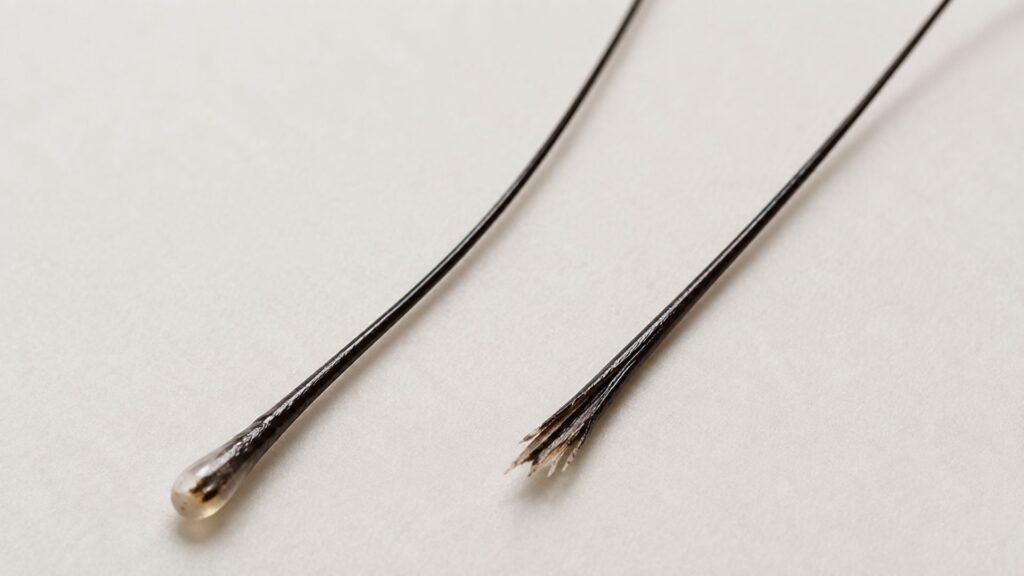
Quick Answer: Hair Fall vs Hair Breakage
| Hair Fall / Shedding | Hair Breakage |
|---|---|
| Hair comes out from the scalp | Hair snaps along its length |
| Usually a complete-length strand | Often shorter pieces |
| Can be related to genetics, stress, illness, hormones or other factors | Often related to heat, chemicals, tension or mechanical damage |
| May cause reduced density | Often causes frizz, uneven lengths and split ends |
| Can require medical evaluation | Often requires better hair-care and damage control |
| May happen with or without visible scalp symptoms | Usually affects the hair shaft |
Important: A person can experience both hair shedding and breakage at the same time. (American Academy of Dermatology)
1. What Is Hair Shedding?
Hair shedding is a normal part of the hair-growth cycle.
Hair grows, enters a resting phase and eventually sheds. The AAD states that shedding around 50–100 hairs per day can be normal, although the actual amount varies between individuals. (American Academy of Dermatology)
You may notice shed hair:
- on your pillow
- in your shower
- in your hairbrush
- on your clothes
- on the floor
Seeing individual hairs does not automatically mean that you have a hair-loss disorder.
When does shedding become concerning?
If you suddenly notice substantially more hair coming out than usual, or you develop:
- visible thinning
- a widening part
- a receding hairline
- bald patches
- reduced ponytail thickness
it may be worth getting evaluated by a dermatologist. (American Academy of Dermatology)
2. What Is Hair Breakage?
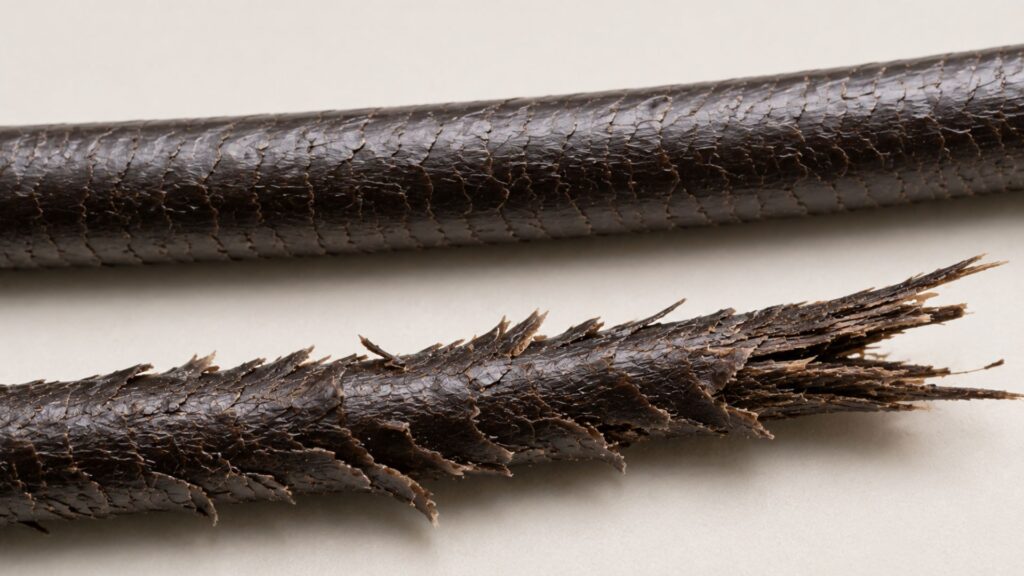
Hair breakage is different.
Instead of the entire strand being shed from the scalp, the hair shaft breaks somewhere along its length.
This can leave you with:
- short hairs
- uneven lengths
- frizzy ends
- split ends
- rough texture
- flyaways
- increased hair on your brush
The AAD notes that damaged hair is fragile and more likely to break, and excessive styling can contribute to brittle, frizzy-looking hair. (American Academy of Dermatology)
3. The Easiest Way to Tell Them Apart
Look at the hairs you’re finding.
If you’re seeing mostly:
Long, complete strands → you may be experiencing shedding.
Short, uneven pieces → breakage may be contributing.
But don’t rely on strand length alone.
Someone with long hair may naturally shed long strands, while someone with short hair may shed shorter strands.
The overall pattern matters more than one strand.
4. What Does a Shed Hair Look Like?
A naturally shed hair generally represents a strand that has completed its growth cycle.
You may find a long strand similar in length to the hair growing on your head.
The important point is that the hair has come out from the follicle, rather than snapping somewhere in the middle.
5. What Does Broken Hair Look Like?
Broken hair is usually easier to recognize when you examine several strands.
You may notice:
- different lengths
- tiny broken pieces
- frayed ends
- split ends
- short hairs around the crown or hairline
- increased frizz
- roughness
The AAD notes that hair breakage can make some hairs shorter than others and can increase the number of hairs you see on your brush. (American Academy of Dermatology)
6. Common Causes of Hair Shedding
Hair shedding can have many causes.
Some include:
Genetics
Hereditary hair loss is one of the most common forms of hair loss and can cause gradual thinning. (American Academy of Dermatology)
Stress
Significant physical or emotional stress can trigger excessive shedding.
Illness or high fever
Increased shedding may occur after a significant illness.
Pregnancy and postpartum changes
Hormonal changes around pregnancy and childbirth can affect the hair-growth cycle.
Rapid weight loss
Significant weight loss can trigger excessive shedding.
Hormonal or thyroid changes
Certain hormonal and medical conditions can affect hair growth.
Medications
Some medications can contribute to hair loss.
These causes are why persistent or significant shedding shouldn’t automatically be blamed on shampoo, oiling or a salon treatment. (American Academy of Dermatology)
7. Common Causes of Hair Breakage
Breakage is often connected to how the hair is handled and processed.
Excessive heat
Frequent use of:
- straighteners
- curling irons
- hot blow-drying
can contribute to hair damage.
Bleaching and chemical processing
Repeated bleaching, colouring, straightening or other chemical processing can weaken the hair shaft.
Aggressive brushing
Too much brushing or rough detangling can contribute to breakage.
Tight hairstyles
Repeated tension from tight ponytails, braids, buns or extensions can damage hair and, in some circumstances, contribute to hair loss as well. (American Academy of Dermatology)
Rough handling when wet
Wet hair can be more vulnerable to breakage. The AAD recommends minimizing handling of wet hair for most people, while noting that some tightly curled or textured hair may be easier to detangle when wet. (American Academy of Dermatology)
8. Can Hair Breakage Look Like Hair Fall?
Absolutely.
This is one of the most common reasons people become confused.
Imagine you have long hair.
If 20 short pieces break off while brushing, you may see 20 hairs in your brush and assume you’re losing hair from the scalp.
But the actual problem may be damage to the hair shaft.
Look for:
Short pieces + uneven lengths + frizz + split ends = possible breakage
rather than assuming it is a follicle-level hair-loss problem.
9. Can You Have Hair Fall and Breakage at the Same Time?
Yes.
This is extremely important.
For example, someone could have:
Genetic hair thinning + chemically damaged ends
or:
Stress-related shedding + heat-related breakage
or:
Postpartum shedding + frequent tight hairstyles
In these situations, reducing hair damage may improve breakage while a dermatologist evaluates the underlying shedding.
The AAD notes that some people can have more than one cause of hair loss or shedding at the same time. (American Academy of Dermatology)
10. Hair Fall vs Breakage: What You See in the Mirror
Hair shedding / hair loss may look like:
- widening part
- thinner ponytail
- receding hairline
- visible scalp
- bald patches
- gradual reduction in density
These are recognized signs of hair loss. (American Academy of Dermatology)
Hair breakage may look like:
- frizz
- short flyaways
- uneven lengths
- split ends
- rough texture
- visibly damaged ends
You may still have good overall density even though the hair looks unhealthy.
11. Simple At-Home Observation
You don’t need a complicated test to start paying attention.
Step 1: Look at the length
Are the hairs you’re finding mostly similar to your normal hair length?
Or are there lots of short pieces?
Step 2: Look at your hairline
Has the hairline changed?
Step 3: Look at your parting
Is your part becoming noticeably wider?
Step 4: Look at the ends
Are they:
- split?
- frayed?
- rough?
- uneven?
Step 5: Check your scalp
Do you have:
- itching?
- redness?
- scaling?
- pain?
- crusting?
If you notice significant scalp symptoms or sudden/patchy hair loss, seek medical evaluation.
12. How to Reduce Hair Breakage
If breakage appears to be part of the problem, focus on reducing mechanical and chemical stress.
Shampoo gently
Apply shampoo primarily to the scalp rather than aggressively rubbing the lengths.
Condition regularly
The AAD recommends conditioning after shampooing because conditioner can coat the hair shaft and help reduce breakage and split ends. (American Academy of Dermatology)
Detangle carefully
Use an appropriate comb or brush and avoid aggressive pulling through knots.
Reduce excessive heat
Give your hair breaks from frequent high-temperature styling.
Protect chemically treated hair
If your hair is coloured, bleached or chemically treated, follow an appropriate professional aftercare routine.
Avoid excessive tension
Rotate hairstyles and avoid repeatedly pulling the hair tightly.
13. What About Hair Spa Treatments?
A hair spa or conditioning treatment can help improve the feel, softness and manageability of damaged hair.
It may be useful when your primary issue is:
- dryness
- roughness
- frizz
- poor manageability
- cosmetic damage
But a hair spa should not be presented as a cure for medical hair loss.
If your problem is actually hereditary hair loss, alopecia, significant shedding or another scalp disorder, the underlying cause needs appropriate assessment.
14. When Should You See a Dermatologist?
Don’t assume every hair problem can be solved with better hair products.
Consider seeing a dermatologist if you notice:
- sudden significant shedding
- rapidly increasing thinning
- bald patches
- a rapidly receding hairline
- widening parting
- persistent scalp pain
- intense itching
- redness or inflammation
- scaling or crusting
- unexplained loss of eyebrow/body hair
A dermatologist can examine your scalp and hair and determine whether you’re experiencing shedding, breakage, hair loss or a combination. Depending on the suspected cause, medical evaluation may include your history, scalp examination and sometimes blood tests or other investigations. (American Academy of Dermatology)
15. What Should You NOT Do?
If you’re worried about hair fall, avoid immediately:
❌ Taking random supplements
❌ Starting multiple new products at once
❌ Aggressively oiling the scalp
❌ Brushing excessively
❌ Pulling at your hair to “test” it repeatedly
❌ Using high heat every day
❌ Wearing extremely tight hairstyles
❌ Stopping prescribed medication without speaking to your doctor
The AAD specifically advises speaking with a doctor if you suspect a medication is causing hair loss rather than stopping it yourself. (American Academy of Dermatology)
Hair Fall vs Hair Breakage: The 30-Second Checklist
Ask yourself these questions:
Are you seeing shorter pieces?
Yes → Breakage may be involved.
Is your overall hair density decreasing?
Yes → Hair loss/shedding should be considered.
Is your part becoming wider?
Yes → Consider professional evaluation.
Are your ends split and frizzy?
Yes → Damage/breakage may be contributing.
Did your shedding increase after illness, major stress, weight loss or childbirth?
Yes → Excessive shedding may be involved.
Are you experiencing bald patches?
Yes → See a dermatologist.
Do you have scalp pain, redness, scaling or inflammation?
Yes → Seek medical evaluation.
What Is the Best Solution?
There isn’t one universal “hair fall treatment.”
The right approach depends on what is actually happening.
If it’s primarily breakage:
Focus on:
Gentle handling → Conditioning → Damage reduction → Heat protection → Appropriate professional hair care
If it’s excessive shedding:
Focus on:
Identifying the trigger → Medical assessment when appropriate → Addressing the underlying cause
If it’s hereditary hair loss:
Early professional diagnosis is important because treatment options depend on the type and cause of hair loss. (American Academy of Dermatology)
If it’s both:
You may need to address the scalp/hair-growth issue and the hair-shaft damage separately.
How Kapil’s Salon Can Help
A professional salon consultation can be useful for assessing the cosmetic condition of the hair.
A stylist can look at:
- hair texture
- visible breakage
- split ends
- dryness
- frizz
- chemical-processing history
- styling habits
- overall manageability
Based on this, the stylist can recommend appropriate hair-care, conditioning, haircut or salon-treatment options.
However, suspected medical hair loss should be evaluated by a dermatologist.
This distinction is important:
A salon can help you care for and improve the appearance of your hair. A dermatologist diagnoses medical hair and scalp conditions.
Frequently Asked Questions
How do I know if my hair is falling from the root or breaking?
Look at the overall pattern. Complete-length strands and reduced density may suggest shedding, while many shorter uneven pieces, frizz and damaged ends suggest breakage. However, only a professional assessment can determine the underlying cause with confidence.
Is hair breakage the same as hair loss?
No. Breakage occurs when the hair shaft snaps, while hair loss involves reduced hair growth or loss from the scalp. They can occur together.
Why is my hair breaking but not falling from the root?
Your hair may be experiencing shaft damage from heat, chemical processing, tension, rough handling or other mechanical stress.
Why am I losing short hairs?
Short hairs can result from breakage, but short hairs can also occur in certain hair-loss conditions. Look at the overall density, scalp and hair pattern rather than relying on strand length alone.
Does hair breakage cause thinning?
Significant breakage can make hair appear thinner and uneven. Continued damage can contribute to a visibly reduced amount of hair, but true scalp-level hair loss has other causes as well. (American Academy of Dermatology)
Can hair spa stop hair fall?
A hair spa may improve conditioning, softness and manageability, but it should not be presented as a treatment for medical hair loss.
Does oiling prevent hair breakage?
Oiling isn’t a universal solution. Hair breakage is better addressed by reducing damaging practices, conditioning appropriately and handling hair gently.
Does cutting hair stop hair fall?
No. A haircut cuts the hair shaft and does not treat a condition affecting the hair follicle.
Can damaged hair repair itself?
Hair that has already been damaged cannot be biologically restored to its original state. However, appropriate conditioning and reduced damage can improve how the hair looks and feels while preventing further breakage.
When should I see a dermatologist for hair fall?
See a dermatologist if you develop sudden or significant shedding, bald patches, progressive thinning, a changing hairline or concerning scalp symptoms. (American Academy of Dermatology)
The Bottom Line
Hair fall and hair breakage are not the same thing.
If you’re seeing short, uneven, frizzy or split hairs, damage and breakage may be part of the problem.
If you’re noticing reduced density, a widening part, receding hairline, bald patches or unusually increased shedding, hair loss or excessive shedding may need to be investigated.
And remember—you can have both at the same time.
The smartest first step is not to buy another product.
Find out what is actually happening to your hair.
Expert Reviewed By
Kapil Sharma
Founder & Creative Director, Kapil’s Salon & Academy
Professional Hairdressing & Salon Industry Expert
Use the “Expert Reviewed” wording only after the article has actually been reviewed by the named person.
Medical editorial note: This article should educate readers, not diagnose them. For persistent, sudden, patchy or progressive hair loss, direct the reader to a dermatologist. The AAD specifically notes that dermatologists can distinguish hair loss from excessive shedding and identify underlying causes. (American Academy of Dermatology)