

How Often Should You Wash Your Hair?
There is no single “correct” number of hair washes for everyone.
Some people need to shampoo almost every day. Others can comfortably go several days between washes.
Your ideal hair-washing frequency depends mainly on:
- Scalp oiliness
- Hair texture
- Hair length
- Sweating and activity
- Dandruff or scalp conditions
- Chemical treatments
- Styling-product buildup
- Age and hormonal changes
- Your individual scalp and hair needs
Dermatologists generally recommend adjusting your washing routine to your scalp and hair type rather than following a fixed rule. Cleveland Clinic notes that fine or oily hair may need more frequent washing, while coarse, curly or dry hair may need less frequent washing.
For Indian hair, this becomes especially relevant because straight, wavy, curly, fine, thick, oily and chemically treated hair can all require different routines.

Quick Answer: How Often Should You Wash Your Hair?
As a starting point:
| Hair / Scalp Type | Possible Starting Frequency |
|---|---|
| Very oily scalp + fine/straight hair | Daily or every 1–2 days |
| Normal scalp + straight/wavy hair | Every 2–3 days |
| Dry or damaged hair | Every 3–4 days or as needed |
| Thick/coarse hair | Every 3–7 days, depending on scalp |
| Curly/coily hair | When needed; avoid unnecessary washing |
| Very sweaty scalp | Wash when needed, particularly after heavy sweating |
| Dandruff-prone scalp | Follow an appropriate dandruff-shampoo routine |
| Chemically treated hair | Adjust frequency to scalp oiliness while protecting lengths |
These are starting points, not medical rules. Your scalp’s condition should ultimately determine your routine.
The American Academy of Dermatology also recommends choosing shampoo frequency according to hair type—for example, more frequent washing for fine/straight or oily hair and less frequent washing for coarse/curly hair.
Why Does Hair-Washing Frequency Matter?
Your scalp produces sebum, a natural oil that helps protect the skin and hair.
At the same time, your scalp can accumulate:
- sweat
- dead skin cells
- excess oil
- styling products
- environmental particles
- microorganisms naturally present on the scalp
Regular cleansing helps manage this buildup.
But washing too frequently—or washing aggressively—can leave the hair lengths dry and more vulnerable to damage.
Cleveland Clinic notes that washing too often can contribute to dryness and breakage, while inadequate cleansing can be associated with itching, flaking and scalp inflammation.
So the goal isn’t:
“Wash as little as possible.”
And it isn’t:
“Wash every day no matter what.”
The goal is:
Keep your scalp clean and comfortable without unnecessarily drying or damaging your hair lengths.
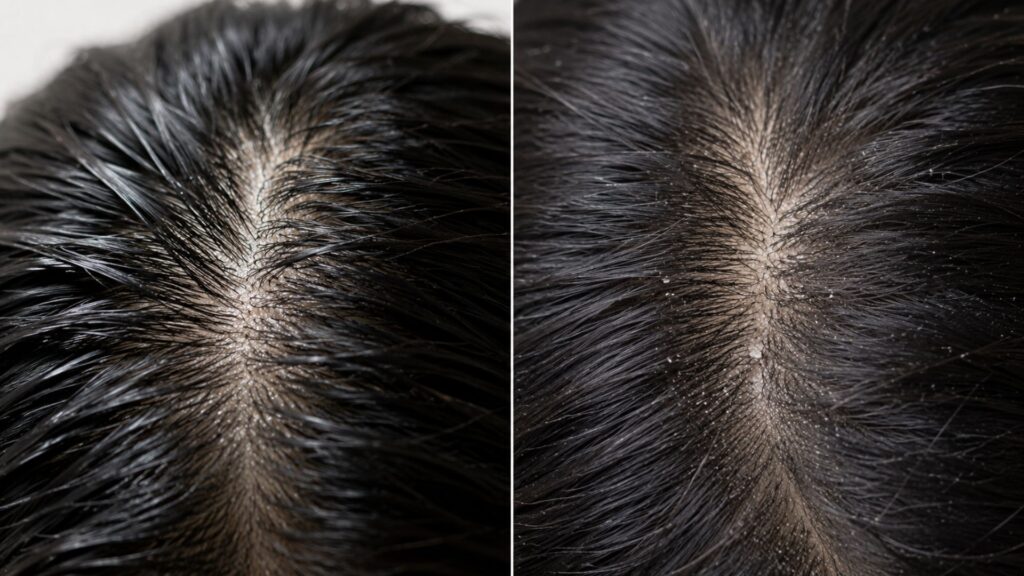
How Often Should You Wash Oily Hair?
If your scalp becomes greasy quickly, you may need to wash more frequently.
Signs your scalp may need more frequent washing:
- greasy roots
- hair looks flat shortly after washing
- scalp feels uncomfortable
- itching
- noticeable buildup
- dandruff or flaking
- scalp pimples or bumps
People with fine, straight hair often notice oiliness faster because sebum can spread more easily along the hair shaft.
The AAD says people with fine or naturally straight hair, or an oily scalp, may need to shampoo more often—even daily in some cases.
Kapil’s recommendation:
Don’t force yourself to follow a “three washes per week” rule if your scalp is clearly oily after one or two days.
Your scalp is giving you feedback.
How Often Should You Wash Dry Hair?
Dry hair generally doesn’t need to be washed as frequently.
If your hair feels:
- rough
- brittle
- frizzy
- tangled
- excessively dry
- prone to breakage
washing less frequently may help preserve the hair’s natural oils.
This is particularly relevant for long, coarse, curly or chemically treated hair, where the natural oils from the scalp may take longer to travel down the hair shaft.
But remember:
Dry hair does not mean dirty hair.
You still need to cleanse your scalp appropriately.
How Often Should You Wash Curly Hair?
Curly and coily hair often needs a different approach.
The shape of the hair makes it harder for scalp oils to travel down the entire length, which can make the lengths feel dry even when the scalp produces oil.
The AAD notes that curly or tightly coiled hair is more prone to dryness and breakage and recommends washing only when needed rather than automatically washing daily.
Focus on:
Scalp cleansing + adequate conditioning + gentle handling.
Don’t use the same washing schedule as someone with fine, straight, oily hair simply because they have the same number of days in a week.
How Often Should You Wash Coloured or Chemically Treated Hair?
Hair colouring, bleaching, straightening and other chemical processes can make the hair fibre more fragile.
If you have chemically treated hair, the objective is to:
Clean the scalp → Protect the lengths → Minimize unnecessary damage
You may be able to extend the time between washes if your scalp isn’t oily.
But don’t avoid washing simply to “protect your colour” if your scalp becomes oily, itchy or uncomfortable.
A better strategy is to use an appropriate shampoo and conditioner and focus shampoo mainly on the scalp.
Cleveland Clinic specifically recommends applying shampoo primarily to the scalp and conditioner toward the ends, particularly for longer hair.
Should You Wash Your Hair Every Day?
The answer is: sometimes.
Daily washing isn’t automatically bad.
If you have:
- an oily scalp
- fine hair
- heavy sweating
- frequent outdoor activity
- scalp buildup
you may benefit from more frequent washing.
On the other hand, daily shampooing may not be necessary for someone with:
- dry hair
- coarse hair
- curly/coily hair
- a dry scalp
- chemically treated lengths
Cleveland Clinic notes that people with oily scalps may choose daily washing, while coarse, coiled or tightly curled hair generally needs much less frequent washing.
So:
Daily washing isn’t universally good or bad. It depends on the scalp.
What About Indian Weather?
This is where your hair routine may need to change throughout the year.
India has significant differences in:
- temperature
- humidity
- pollution
- monsoon conditions
- seasonal dryness
- activity levels
In hot and humid conditions, you may sweat more and feel the need to cleanse your scalp more frequently.
But don’t confuse frizz with dirt.
Humidity can make hair feel:
- puffier
- frizzier
- harder to manage
- more tangled
That doesn’t automatically mean you need to shampoo more often.
Instead, look at the scalp.
If your scalp is comfortable and clean but your lengths are frizzy, your problem may be hair moisture and damage management, not insufficient shampooing.
Should You Wash Your Hair After Exercise?
Not necessarily every single time.
If you’ve had a light workout and your scalp isn’t particularly sweaty or oily, you may not need a full shampoo immediately.
But if you’ve had:
- heavy sweating
- an intense workout
- outdoor exercise
- prolonged helmet use
- significant scalp oiliness
cleansing may make sense.
Cleveland Clinic notes that exercise and sweating can influence washing needs, but daily exercise does not automatically mean you must shampoo every day.
Simple rule:
Wash based on your scalp—not just your workout calendar.
Does Washing Hair Cause Hair Fall?
This is one of the biggest myths.
You may notice more hair in the shower on wash day and think:
“My shampoo is causing hair fall.”
Not necessarily.
Hair that has already completed its growth cycle can remain tangled among other hairs until washing or brushing dislodges it.
This can make the amount visible on wash day appear higher.
Cleveland Clinic notes that people who wash less frequently may see more hair shedding on wash days simply because more loose hairs have accumulated between washes.
Important distinction
Seeing shed hair during washing ≠ shampoo causing hair loss.
However, aggressive washing, rough detangling or harsh products can contribute to hair damage and breakage.
Can Washing Your Hair Too Much Cause Hair Damage?
Potentially, yes.
The issue isn’t simply the number of washes.
It’s the combination of:
frequency + shampoo formulation + water temperature + technique + hair type + conditioning
Over-cleansing can leave some hair types excessively dry.
This is particularly relevant for:
- curly hair
- coarse hair
- bleached hair
- chemically treated hair
- already damaged hair
Cleveland Clinic notes that excessive washing can dry hair and contribute to breakage.
What Happens If You Don’t Wash Your Hair Enough?
Going too long between washes isn’t automatically healthier either.
Excessive buildup may contribute to:
- greasy roots
- unpleasant scalp odor
- itching
- flaking
- dandruff
- scalp irritation
- product buildup
Cleveland Clinic notes that itching, redness, flaking and dandruff can be signs that the scalp isn’t being adequately cleansed.
The AAD similarly recommends regular washing as part of managing dandruff, with frequency adjusted according to hair type and scalp oiliness.
How Do You Know It’s Time to Wash Your Hair?
Instead of counting days, look for signals.
Your scalp may need cleansing when:
1. Roots become greasy
Your scalp feels oily or your hair looks visibly greasy.
2. You start itching
Persistent itching can have several causes, including dandruff and scalp conditions.
3. You notice buildup
Styling products may accumulate on the scalp and hair.
4. You have significant sweating
Especially after intense exercise or outdoor activity.
5. You notice flaking
Persistent dandruff should be addressed appropriately.
6. Your scalp feels uncomfortable
Your scalp—not just your hair lengths—should guide your washing schedule.
The Correct Way to Shampoo Your Hair
Washing frequency is only half the equation.
How you wash matters too.
Step 1: Completely wet your hair
Use comfortably warm water.
Avoid extremely hot water.
Step 2: Apply shampoo to your scalp
Don’t aggressively scrub the lengths.
Your primary target is the scalp.
Step 3: Massage gently
Use your fingertips rather than scratching with your nails.
Step 4: Rinse thoroughly
Make sure shampoo is properly removed.
Step 5: Condition the lengths
Apply conditioner mainly through the mid-lengths and ends, particularly if your hair is long or dry.
Cleveland Clinic specifically recommends shampooing the scalp and conditioning the ends to reduce unnecessary dryness and breakage.
Step 6: Dry gently
Don’t aggressively rub wet hair with a towel.
The AAD recommends gentle hair care and notes that wet hair can be vulnerable to damage.
Should You Shampoo Twice?
Not everyone needs to shampoo twice.
A second cleanse can sometimes be useful when:
- the scalp is very oily
- you’ve used significant styling products
- there is substantial buildup
- the first wash doesn’t adequately cleanse the scalp
But if your scalp and hair are already clean, repeatedly shampooing isn’t automatically better.
Focus on effective cleansing rather than maximum lather.
Should You Condition Every Time You Shampoo?
For most hair types, conditioning after shampooing is a useful part of the routine.
Conditioner helps improve:
- softness
- manageability
- detangling
- smoothness
The AAD recommends moisturizing conditioner after shampooing, particularly because it can help reduce breakage and split ends.
But placement matters.
Oily scalp: Keep heavier conditioner away from the roots if it makes them greasy.
Dry/long hair: Focus conditioner through the lengths and ends.
What About Dandruff?
If you have dandruff, simply washing less frequently may not solve the problem.
The AAD recommends regular washing and, when needed, dandruff shampoos containing appropriate active ingredients. The frequency depends on hair type and scalp needs.
Common dandruff-shampoo active ingredients include:
- ketoconazole
- selenium sulfide
- salicylic acid
- zinc pyrithione
- coal tar
Follow the product instructions because some medicated shampoos need to remain on the scalp for several minutes before rinsing.
If persistent dandruff, itching, redness or scalp inflammation doesn’t improve, consult a dermatologist.
What About Hair Oiling Before Shampoo?
Hair oiling is common in Indian hair-care routines.
But more oil doesn’t automatically mean healthier hair.
If you enjoy oiling, consider it as part of your personal hair-care routine rather than a universal treatment for hair loss.
Avoid aggressive scalp massage, particularly if your scalp is irritated.
And don’t leave heavy oil on an oily or dandruff-prone scalp simply because you believe “longer is better.”
Your scalp condition should guide the routine.
Hair Wash Frequency by Indian Hair Type
Fine + Straight + Oily
Try: Every 1–2 days, potentially daily if needed.
Focus on:
- gentle scalp cleansing
- lightweight conditioner
- avoiding heavy products near roots
Straight + Normal Scalp
Try: Every 2–3 days.
Adjust based on oiliness, sweating and buildup.
Wavy Hair
Try: Every 2–4 days.
Watch the scalp rather than simply following a calendar.
Thick + Coarse Hair
Try: Every 3–7 days, depending on scalp oiliness.
Prioritize:
- scalp cleansing
- conditioning
- detangling
- moisture management
Curly / Coily Hair
Try: Wash when needed rather than automatically washing every day.
The AAD emphasizes that curly/coily hair is more prone to dryness and breakage and should generally be washed according to need.
Chemically Treated Hair
Try: Base frequency primarily on scalp oiliness while minimizing unnecessary stress on the treated lengths.
Use:
- gentle cleansing
- appropriate conditioner
- heat protection
- professional aftercare
The Biggest Hair-Washing Mistakes
Mistake #1: Following someone else’s schedule
Your friend’s hair isn’t your hair.
Mistake #2: Washing only because “it’s Sunday”
Your scalp doesn’t know what day it is.
Mistake #3: Avoiding shampoo because you’re experiencing hair fall
Hair loss has many causes. Reducing shampoo frequency doesn’t necessarily address the underlying cause. The AAD recommends medical evaluation when hair loss is occurring rather than relying solely on changing hair-care habits.
Mistake #4: Scrubbing aggressively
Clean doesn’t mean aggressively scrubbed.
Mistake #5: Putting conditioner heavily on an oily scalp
This can make roots look greasy faster.
Mistake #6: Using very hot water
Very hot water can contribute to dryness and irritation.
Mistake #7: Ignoring persistent dandruff
If itching and flaking continue despite appropriate care, get the scalp evaluated.
What Is the Best Hair-Washing Schedule for You?
Here’s the simplest way to find out.
Start with your current routine.
Then ask:
After 1 day:
Is my scalp oily?
After 2 days:
Does it feel comfortable?
After 3 days:
Am I getting greasy roots, itching or buildup?
After 4+ days:
Does my scalp remain comfortable and clean?
Use these observations to adjust your schedule.
Remember:
Your scalp determines cleansing frequency.
Your hair lengths determine how gently you should cleanse and condition.
That’s the key distinction.
When Should You See a Dermatologist?
Hair-washing frequency won’t solve every hair or scalp problem.
See a dermatologist if you experience:
- sudden or significant hair loss
- bald patches
- rapidly increasing thinning
- persistent scalp redness
- severe itching
- painful scalp
- persistent dandruff
- sores or crusting
- unexplained changes in hair density
Hair loss can have many causes, and the AAD recommends professional evaluation to identify the underlying cause rather than relying solely on hair products or supplements.
Kapil’s Salon Expert Tip
Don’t ask, “How many times should I wash my hair?”
Ask, “How often does MY scalp need cleansing while keeping MY hair lengths healthy?”
That’s a much better question.
At Kapil’s Salon, a professional hair consultation can help you understand your hair texture, scalp oiliness, visible damage, chemical-treatment history and styling habits, and build a practical salon and home-care routine around your needs.
However, persistent scalp conditions or unexplained hair loss should be evaluated by a dermatologist.
Frequently Asked Questions
Is it okay to wash your hair every day?
Yes, for some people. Fine hair or an oily scalp may require frequent washing, including daily washing. Dry, coarse or curly hair may need much less frequent washing.
Is washing hair three times a week enough?
It can be for some people, but not everyone. Your scalp oiliness, hair texture, activity level and scalp condition matter more than a universal number.
How many times should Indians wash their hair?
There is no scientifically established “Indian” number. A practical starting point is 2–3 washes per week for many people, then adjust upward for oily/sweaty scalps and downward for dry, coarse or curly hair.
Is it bad to wash hair every day?
Not necessarily. Daily washing can be appropriate for an oily scalp or fine straight hair. However, frequent washing can contribute to dryness and breakage in some hair types.
Should I wash my hair after sweating?
If your scalp becomes very sweaty, oily or uncomfortable, washing can be appropriate. But exercising every day doesn’t automatically mean you must shampoo every day.
Does washing hair cause hair fall?
Washing can dislodge hairs that were already ready to shed, making hair loss look more noticeable on wash day. It does not mean shampoo caused the underlying hair loss.
Should I wash my hair before or after oiling?
If you oil your hair, shampooing afterward can remove excess oil. Avoid aggressive scrubbing or excessive oiling, especially if your scalp is oily or prone to dandruff.
Should shampoo be applied to the hair or scalp?
Primarily the scalp. Cleansing the scalp removes oil and buildup, while the shampoo that runs through the lengths during rinsing is generally enough for many people.
Should conditioner go on the scalp?
Usually, conditioner is better focused on the lengths and ends, particularly for longer hair. Applying heavy conditioner directly to an oily scalp can make it look greasy.
Can I go a week without washing my hair?
Some people with dry, coarse or curly hair may comfortably go several days between washes. However, if you develop oiliness, itching, flaking or buildup, your scalp may need more frequent cleansing.
Does washing less make hair grow faster?
No. Reducing shampoo frequency does not automatically make hair grow faster. Hair growth depends on the biology of the hair follicle and other factors.
Final Takeaway
There is no universal hair-washing schedule.
The best routine balances two things:
Clean scalp
Oil + sweat + buildup → appropriately cleanse
Healthy hair lengths
Dryness + chemical damage + heat → protect and condition
For many Indians, 2–3 washes per week can be a useful starting point, but someone with a very oily scalp may need more frequent washing, while someone with dry, coarse or curly hair may need less.
So forget the rigid rule:
“Wash your hair exactly X times a week.”
Instead:
Watch your scalp. Understand your hair type. Adjust your routine.
Expert Reviewed By:
Kapil Sharma
Founder & Creative Director, Kapil’s Salon & Academy
Professional Hairdressing & Salon Industry Expert